
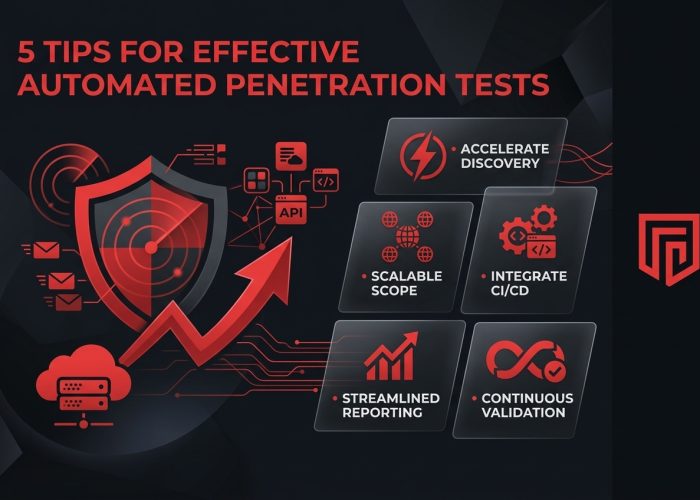
Penetration testing has been a cybersecurity staple since the advent of the website. Simulated attacks are still the best way to uncover vulnerabilities and loopholes that could allow malicious actors a way into your systems, sites, apps and data, but it’s important to continuously update your pen test methods in order to maintain relevance amid the latest tech advances.
Today, the most effective pen tests have replaced manual tests with automated workflows. Automated penetration testing (APT) offers many benefits, including lower resource demands and faster tests. Once penetration testing is automated, you can run tests more frequently, scale up to large environments, and individually check smaller environments.
Once you upgrade to APT, you’ll never look back. But it’s worth making sure that your automated tests are as efficient as possible. Here are five tips for enhancing automated penetration testing for maximum impact.
1. Automate Patch Management with Continuous Testing Feedback Loops
Automating penetration testing can set off a chain reaction that enhances security across multiple workflows and use cases. Patch management should be the first in line. Integrate automated pen testing outputs directly into patch workflows like ticketing or CI/CD pipelines.
As soon as the system finds outdated software, the patch management tool remediates it, reducing the window of exposure and removing reliance on manual processes. This creates a closed-loop system that lowers the risk of delays leaving vulnerabilities ripe for exploitation.
Asset discovery continuously detects outdated or unpatched systems, ensuring that vulnerabilities are uncovered quickly. It’s best to set up real-time alerts for newly discovered vulnerabilities, so as to shorten remediation time. Detection immediately triggers action, so there’s no risk of security teams becoming so overwhelmed with tasks that they forget to apply a patch.
2. Prioritize Vulnerabilities According to Real Business Impact
To make APT more efficient, direct your remediation efforts towards the most business-critical vulnerabilities. Customize risk scoring models for your greatest business pain points, such as revenue-generating systems or customer data, because relying on generic CVSS approaches obscures the potential operational impact of a given vulnerability.
Enrich APT findings with information about your business context, like data sensitivity, user access, and exploitability.
This approach prevents teams from wasting time, energy, and resources on low-risk issues while critical exposures remain open, and keeps everyone focused on the issues that matter most to your organization rather than a vulnerability’s technical severity level.
3. Validate Automated Findings with Periodic Manual Reviews
Automation vastly enhances the speed, scalability, and accuracy of penetration testing, but it can be a mistake to over-rely on it.
Automated tools can miss nuanced or logic-based vulnerabilities, so it’s important to overlay their findings with manual reviews that catch and prevent misguided remediation efforts. Adding human validation also helps teams feel more confident about APT outputs.
Run human-led, manual resting from time to time, especially when it comes to probing complex attack paths and chained vulnerabilities, and schedule expert-led reviews to investigate high-risk or ambiguous findings. Automation can also result in false positives. When these appear, track and tune them to improve tool accuracy over time.
4. Customize Testing for Your Apps and Infrastructure
APT tools tend to be developed for generic systems and environments, but every organization is different.
Off-the-shelf solutions can miss vulnerabilities that are unique to certain environments, so adapt tools for your situation and circumstances by developing test cases and exploit modules that are tailored to your proprietary applications. Tailored testing provides deeper, more relevant security insights.
Configure your APT stack to scope and scale to the specifics of your infrastructure, especially if you span multiple cloud environments. Your penetration testing processes need visibility into your APIs, microservices, and cloud-native architectures, and they need the ability to simulate lateral movement and cross-environment attacks in multi-cloud setups.
5. Build Regular Tests and Threat Intel into the Process
The biggest benefit of automated testing is that you can turn testing into a constant norm instead of a periodic activity. Take advantage of that possibility by embedding APT into security policies and CI/CD pipelines, to deliver continuous risk visibility even as environments change.
Tests should be run continuously or at defined intervals, such as after deployments. As you bake testing into your workflows, integrate threat intelligence feeds at the same time. These feeds allow you to simulate emerging attack techniques, aligning findings with known attacker behaviors and real-world scenarios.
Keeping testing aligned with the evolving threat landscape, rather than just known vulnerabilities, makes it more robust and effective.
Automating Pen Testing Brings New Strength to Security Processes
The marriage of automation and penetration testing makes security significantly stronger. Baking in best practices like manual validation and automated patch management, integrating threat intelligence and business impact into workflows, and tailoring tests for specific circumstances allows security teams to maximize the potential. When APT is used efficiently, it enhances operational capabilities and hardens your security posture.