A well-designed network security architecture is crucial for striking the right balance between these two critical aspects. By understanding what is network security, businesses can fortify their defenses against ever-evolving cyber threats without compromising on efficiency.
Pillars of a Robust Security Architecture
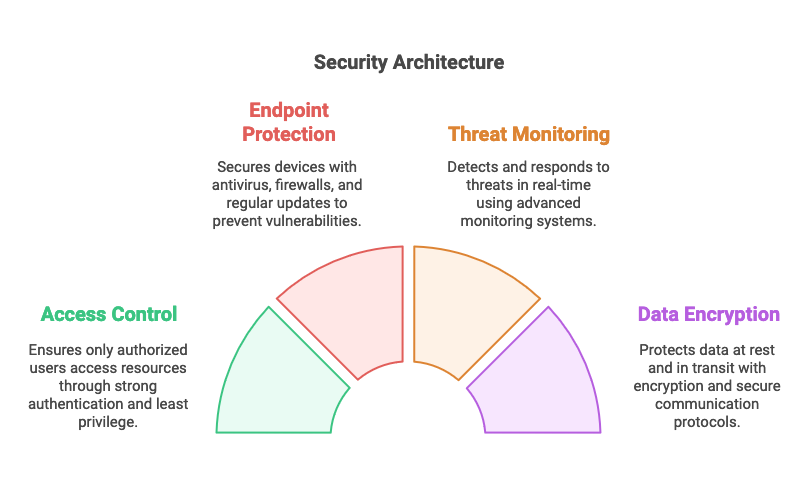
A comprehensive network security architecture consists of several key elements that work together to create a formidable defense against potential threats:
Access Control and Identity Management
- Implement strong authentication mechanisms, such as multi-factor authentication (MFA), to ensure only authorized users can access sensitive resources.
- Establish granular access controls based on the principle of least privilege, granting users only the permissions they need to perform their tasks. A key approach to achieving this is using a privileged access workstation (PAW), which provides a dedicated, hardened environment for sensitive administrative tasks. This helps mitigate risks associated with credential theft and unauthorized access.
Endpoint Protection
- Deploy advanced endpoint protection solutions, including antivirus software, firewalls, and intrusion prevention systems (IPS), to secure devices connected to the network.
- Implement regular patch management and software updates to address known vulnerabilities and maintain a secure endpoint environment.
Threat Monitoring and Incident Response
- Establish a robust threat monitoring system that leverages advanced technologies like security information and event management (SIEM) to detect and respond to potential threats in real-time.
- Develop a well-defined incident response plan that outlines clear procedures for containing, investigating, and recovering from security incidents.
Data Encryption and Secure Communication
- Encrypt sensitive data both at rest and in transit to protect it from unauthorized access and interception.
- Incorporating advanced web protection tools also plays a crucial role in safeguarding network users from online threats. Solutions focused on protecting against malicious websites.
help prevent access to harmful or phishing pages, reducing the risk of data breaches before they occur. - Implement secure communication protocols, such as HTTPS and VPN, to ensure the confidentiality and integrity of data transmitted over the network.
Striking the Right Balance
While implementing advanced security measures is essential, it’s equally important to ensure that these measures don’t hinder network performance. Here are some strategies for achieving an optimal balance:
- Conduct regular network performance assessments to identify and address bottlenecks that may be caused by security controls.
- Implement intelligent traffic inspection techniques, such as deep packet inspection (DPI) solutions, to efficiently analyze network traffic without introducing significant latency.
- Leverage cloud-based security solutions that offload processing and storage requirements from on-premises infrastructure, reducing the impact on network performance.
Real-world examples demonstrate the effectiveness of a balanced approach. For instance, a leading financial institution successfully implemented a zero trust security model while maintaining high network performance by leveraging software-defined networking (SDN) and micro segmentation techniques.
Staying Ahead of the Curve
As cyber threats continue to evolve, organizations must stay proactive in adopting advanced security techniques and technologies:
Zero Trust Security
- Implement a zero trust security model that assumes no implicit trust and continuously verifies the identity and integrity of users, devices, and applications accessing the network.
- Leverage technologies like software-defined perimeter (SDP) and identity-aware proxy (IAP) to enforce granular access controls and reduce the attack surface.
AI and Machine Learning
- Harness the power of artificial intelligence (AI) and machine learning (ML) to enhance threat detection and response capabilities.
- Train ML models on vast amounts of security data to identify patterns and anomalies that may indicate potential threats, enabling proactive defense measures.
Network Segmentation
- Divide the network into smaller, isolated segments based on business functions, data sensitivity, and user roles to limit the lateral movement of threats and minimize the impact of potential breaches.
- Implement virtual local area networks (VLANs), firewalls, and access control lists (ACLs) to enforce segmentation policies and control traffic flow between segments.
Adapting to the Cloud and IoT Era
As organizations increasingly adopt cloud services and Internet of Things (IoT) devices, network security architectures must evolve to address new challenges:
- Embrace secure access service edge (SASE) solutions that combine network security functions with wide area network (WAN) capabilities to provide secure and seamless access to cloud resources.
- Implement robust IoT security measures, such as device authentication, encryption, and regular firmware updates, to mitigate the risks associated with the growing number of connected devices.
Empowering Your Security Posture
To maintain a strong and resilient network security architecture, organizations should prioritize the following best practices:
- Conduct regular security audits and penetration testing to identify and address vulnerabilities before they can be exploited by attackers.
- Implement continuous monitoring and real-time threat detection mechanisms to quickly identify and respond to potential security incidents.
- Provide comprehensive security training and awareness programs for employees to foster a culture of cybersecurity and reduce the risk of human error.
By embracing advanced network security architectures and striking the right balance between security and performance, businesses can protect their digital assets, maintain operational efficiency, and build trust with their customers and stakeholders.
Partnering for Success
Navigating the complexities of network security can be challenging, but organizations don’t have to go it alone. Partnering with a trusted cybersecurity provider like Check Point can help businesses leverage cutting-edge technologies, expert guidance, and comprehensive threat intelligence to fortify their defenses. With a proven track record of delivering innovative security solutions, Check Point empowers organizations to stay ahead of evolving threats while optimizing network performance.
As you embark on your journey to enhance your network security architecture, remember that striking the right balance between protection and performance is key. By following best practices, adopting advanced technologies, and collaborating with trusted partners, you can create a robust and resilient security posture that enables your business to thrive in the digital era.