

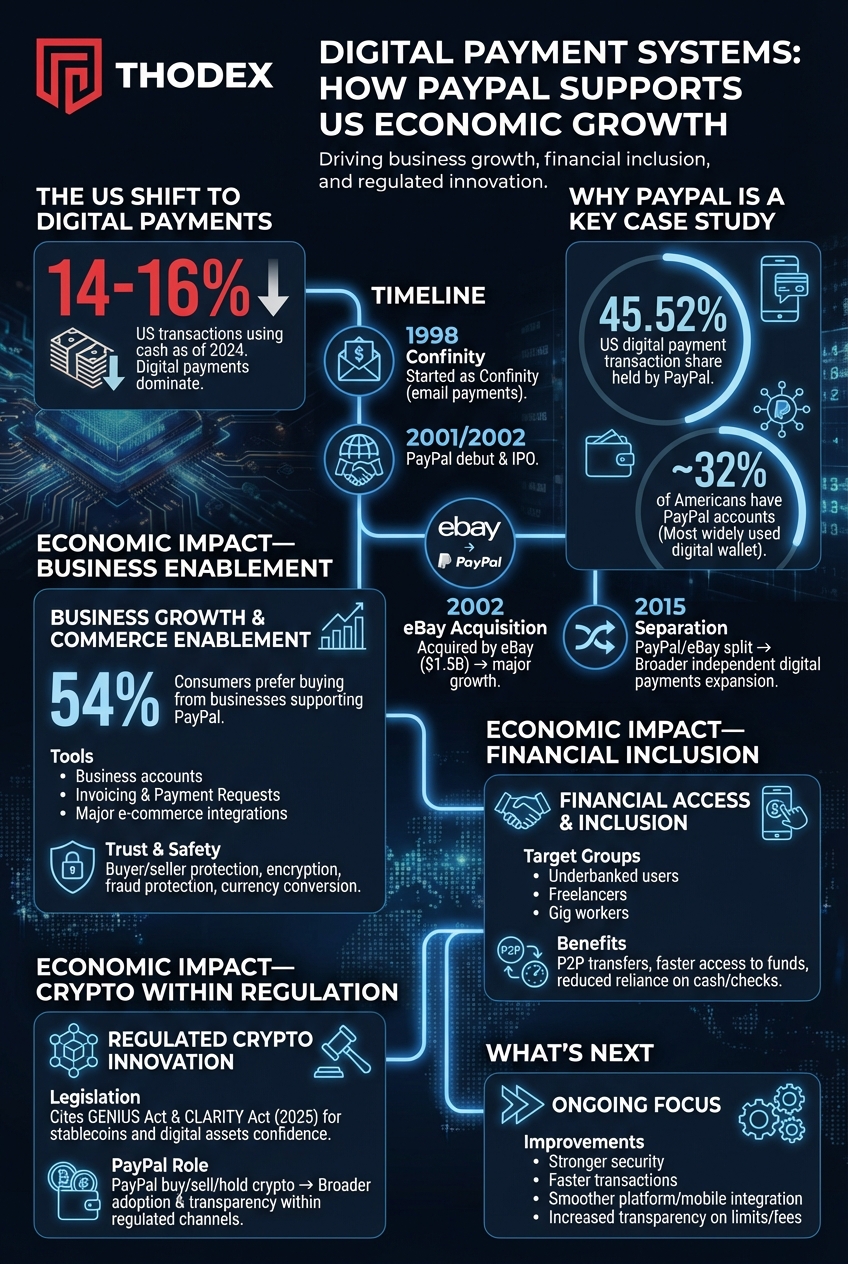
Many Americans use digital payment solutions in their day-to-day lives. In fact, only 14% -16% of US transactions involved cash as of 2024, highlighting how strong the digital payments ecosystem has become. PayPal is among the more established digital payment providers in the United States. With a 45.52% market share of the US digital payment transactions, PayPal serves as a useful case study for evaluating how such platforms contribute to the US economy.
PayPal’s Place in the US Economy
Since its debut in 2001, PayPal has been fundamental in the shift from traditional banking systems to digital, user-focused payment platforms. It began as Confinity in 1998 and later pivoted to digital payments, allowing users to send money securely via email. In 2002, PayPal went public. Soon after, eBay acquired it for $1.5 billion, becoming the platform’s primary payment provider and gaining millions of users.
PayPal’s fraud protection and currency conversion tools supported cross-border e-commerce growth, and by 2011 it was a significant contributor to eBay’s revenue. However, by 2015, PayPal and eBay separated, with PayPal becoming a publicly traded company, with a key focus to expand within the broader digital payments market.
Today, around 32% of Americans have PayPal accounts, making it the most widely used digital wallet in the country. Not to mention it’s the most common payment service in top e-commerce platforms as well as online entertainment platforms such as online casinos. In fact, casinos that support PayPal deposits in the USA are a top choice for their fast and secure transactions compared to traditional bank transfers and card payments.
Supporting All Kinds of Businesses
Research reveals 54% of consumers prefer to buy from businesses that support PayPal payments. For small and medium-sized US businesses, this preference translates into higher conversion rates and easier access to both local and international customers. PayPal business accounts provide a single payment solution, whether customers prefer credit/debit card payments or PayPal transfers.
On top of that, PayPal’s invoicing and payment request tools simplify billing, improving cash flow management for freelancers, entrepreneurs, and service-based businesses. Its integration with major e-commerce systems is another nice perk. Not only does it enable sellers to set up online stores quickly, but it also helps manage transactions, all on one platform.
Through its buyer/seller protection policy, and industry-leading encryption technologies, PayPal reduces the risk of payment-related issues, leaving businesses to focus more on growth and operations. It’s this combination of accessibility, efficiency, and security that empowers more businesses to operate online, reach new markets, and sustain growth, thus supporting the broader US economy.
Promoting Financial Access and Inclusion
PayPal’s flexibility makes it accessible to individuals and businesses who can’t rely on traditional banking services. By offering a digital wallet that allows users to store funds, send and receive payments, and make online purchases, PayPal provides an alternative entry point into the financial system for underbanked users, freelancers, and gig workers. These tools reduce dependence on cash and checks, making day-to-day transactions easier to manage in a digital environment.
Peer-to-peer transfers and quick payment processing also support small-scale economic activity. That includes independent contractors receiving client payments, individuals managing shared expenses, as well as businesses looking for faster access to funds and a simpler payment processor. By enabling more people and businesses to participate in digital transactions, PayPal supports consumer spending, entrepreneurship, along with broader economic activity in the United States.
PayPal and Cryptocurrencies
The contribution of cryptocurrencies to the US economy is no longer a theoretical debate. With the passing of the GENIUS Act (2025), which governs the use of stablecoins in the US, alongside the CLARITY Act (2025) which deals with regulating other digital assets, more Americans, financial institutions, and businesses are confident about using these digital currencies.
Within this environment, PayPal’s crypto integration—where users can buy, sell, and hold cryptocurrencies—contribute to the US-crypto boom. What was once limited to traditional exchanges is now accessible for use in everyday transactions for both consumers and businesses.
From the US economic perspective, this supports innovation while keeping activity within regulated channels. Businesses gain additional payment options, consumers gain flexibility, and crypto use becomes more transparent and traceable. Together, these factors help integrate cryptocurrencies into the broader U.S. digital payments system, supporting financial innovation without bypassing regulatory oversight.
Focus is Still on Improving Efficiency
From its humble beginnings in 1998 as Confinity to the global brand it is now, one thing has stood the test of time. Over the years, PayPal has displayed a consistent ability to adapt to the changing consumer needs in the digital payments space. It expanded from an email-based money transfer option to a fully functional payment ecosystem that supports both consumer activity and business growth.
As technology advances, PayPal users expect more from their favorite e-wallet. That includes more security features, faster transaction processing, as well as smoother integration with platforms and mobile devices. Users also expect more transparency over transaction limits, fees, and account settings. PayPal’s continued updates aim to meet these expectations, which, by default, will continue to contribute to the greater US economy by supporting more reliable and accessible digital payments.