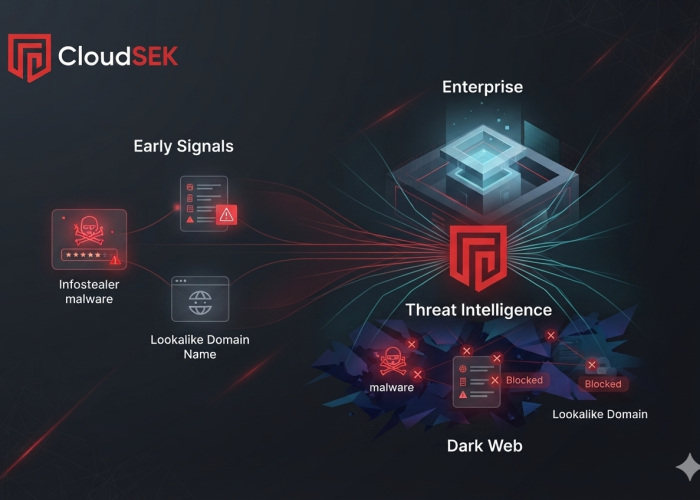
Most breaches do not begin with a zero day. They begin with access: a VPN credential captured by infostealer malware, an employee password circulating in a combo list, a lookalike domain registered for a phishing campaign. These signals surface on dark web forums and marketplaces days or weeks before an attack executes, which makes them the earliest reliable warning an enterprise will get.
The scale of the problem is well documented. Verizon’s 2026 Data Breach Investigations Report found that credential abuse appears somewhere in 39% of all breaches, the single most pervasive technique in its dataset, even after vulnerability exploitation overtook it as the leading initial access vector.
CloudSEK, an AI-native predictive cyber intelligence platform, is built for exactly this window: it identifies attack paths and initial access vectors before they are exploited.
What Is an Initial Access Vector in Cybersecurity?
An initial access vector is the specific entry point an attacker uses to gain a first foothold in a target environment. Common examples include stolen or leaked credentials, internet-exposed services with known CVEs, misconfigured APIs, phishing infrastructure built on lookalike domains, and compromised vendor connections.
MITRE ATT&CK treats initial access as the opening tactic of an intrusion. Everything that follows, from privilege escalation to lateral movement to ransomware deployment, depends on that first step succeeding.
That dependency is what makes initial access vector detection valuable. It is the earliest and cheapest point at which an attack can be stopped. Disrupt the entry point, and the rest of the attack path never executes.
How the Dark Web Supplies Initial Access
Dark web markets function as a supply chain for initial access. Infostealer malware harvests credentials from infected devices, and the resulting logs are sold in bulk on underground marketplaces and encrypted channels. Initial access brokers package working footholds, such as valid VPN or RDP credentials, and sell them to ransomware operators. Phishing kits and fake domains impersonate brands to harvest fresh logins, and exposed code repositories leak API keys that grant direct entry. Continuous dark web monitoring is what surfaces these signals while they are still warnings.
Sequence is consistent: exposure appears first, and the breach follows. Verizon’s 2026 report found that 73% of ransomware victims had an infostealer infection or credential leak in the year before the attack, and half of those events occurred within 95 days of the ransomware.
That window between exposure and exploitation is where predictive defense operates. It is the gap most security stacks cannot see, because it sits entirely outside the firewall.
How CloudSEK Detects Cyber Attacks Before They Happen
CloudSEK identifies attack paths by analysing entry points across five sources: digital risk and dark web exposure (XVigil), threat actor and CVE intelligence (CloudSEK Threat Intelligence), the external attack surface (BeVigil), the AI attack surface (AIVigil), and third-party ecosystems (SVigil). Nexus AI correlates these signals into a predictive attack graph. For dark web and initial access threats specifically, three components do most of the work.
XVigil: digital risk protection for organization-specific exposure
XVigil is CloudSEK’s digital risk protection platform. It monitors deep and dark web forums, paste sites, leaked-data marketplaces, and encrypted channels for direct mentions of an organization, its people, and its assets. Coverage spans leaked credentials, data leaks, brand abuse, fake apps and domains, executive impersonation, and exposed code.
Two things separate this from a generic threat feed. First, the monitoring is organization-specific, so every finding maps to a real exposure rather than industry noise. Second, XVigil prioritizes digital risks based on exploitability and attacker intent, allowing security teams to focus on the exposures that can lead to an attack path. Detection of new credential leak posts and brand abuse activity happens in real time, with end-to-end takedown support for fake domains, fake mobile apps, fraudulent social media pages, and phishing infrastructure.
CloudSEK Threat Intelligence: tracking the actors behind the access
Knowing a credential has leaked answers half the question. The other half is who will use it, and how. CloudSEK Threat Intelligence tracks a continuously growing database of more than 30,000 threat actors, covering their tactics, techniques, and procedures. It monitors actively exploited CVEs, exploitation timelines, and dark web discussion of vulnerabilities, so security teams know which CVEs are weaponized before they are widely exploited.
Ransomware intelligence adds live alerts on global activity, hacktivist campaign tracking, and AI-curated reporting relevant to a customer’s industry and region. It answers a question every SOC eventually asks: who is likely to attack us, what are they exploiting, and how will they do it?
Nexus AI: from dark web signals to validated attack paths
A leaked credential is an alert. A leaked credential that matches an internet-exposed VPN portal, in a sector that a ransomware group is actively targeting, is an attack path. Nexus AI makes that distinction automatically.
Nexus AI is CloudSEK’s attack path intelligence layer. It correlates signals from XVigil, CloudSEK Threat Intelligence, BeVigil, AIVigil, and SVigil into a unified attack graph, showing how an attacker would chain multiple weaknesses into a real, executable attack path. Risks are prioritized by exploitability, impact, and attacker behavior, so teams know what to fix first to break the chain. Where competitors generate alerts, CloudSEK generates the attack graph.
From a Leaked Credential to a Disrupted Attack Path
A typical sequence runs in five steps.
- An infostealer infection on an unmanaged laptop captures an employee’s VPN credentials, and the log is posted to a dark web marketplace within hours.
- XVigil flags the credential in real time because it matches the organization’s monitored domains and assets.
- CloudSEK Threat Intelligence adds adversary context: a ransomware group active in the organization’s sector operates through purchased valid accounts, and dark web chatter shows growing interest in the VPN vendor’s latest CVE.
- BeVigil’s fingerprint of the external attack surface confirms the same VPN portal is internet-exposed.
- Nexus AI correlates these signals into a validated attack path and ranks it above the day’s other findings.
The security team invalidates the credential, hardens authentication on the portal, and closes the path before anyone uses it. No incident, no dwell time, no ransom negotiation. That is the practical difference between reacting to a breach and disrupting an attack path.
Seeing What Attackers See, Before They Act
Attackers assemble access patiently, and the evidence of that assembly appears on the dark web long before execution. Organizations that read those signals, connect them to their own exposure, and act on the resulting attack path hold a structural advantage over organizations that wait for an alert inside the network.
CloudSEK helps enterprises see how attackers will get in before they do. By combining organization-specific dark web monitoring, threat actor tracking, and exploited CVE intelligence and correlating it all through Nexus AI, the platform turns raw external signals into predictive attack path intelligence. Security teams move from alerts to validated attack paths, and from reactive incident response to attacks that never happen.
Frequently Asked Questions
How do you monitor threats on the dark web before a breach?
Effective dark web monitoring is organization-specific. It tracks forums, marketplaces, paste sites, stealer logs, and encrypted channels for mentions of an organization’s domains, credentials, executives, and code, then prioritizes findings by exploitability.
Why do attackers buy access instead of breaking in?
Purchased access is cheaper, quieter, and faster. A valid credential bought from an initial access broker bypasses preventive controls and looks like a legitimate login, letting ransomware operators skip straight to lateral movement.
How is digital risk protection different from cyber threat intelligence?
Digital risk protection tracks exposure specific to one organization, such as leaked credentials and brand abuse. Cyber threat intelligence tracks the adversary side: threat actors, exploited CVEs, malware, and ransomware campaigns.
How can CISOs reduce breach risk using external intelligence?
By detecting initial access vectors early, such as leaked credentials, exposed assets, and dark web targeting, and then correlating them into attack paths. The same intelligence supports predictive risk reporting to boards and regulators.
Does CloudSEK respond to incidents after a breach?
No. CloudSEK identifies and predicts attack paths and does not conduct hands-on incident response. Its role is to surface and prioritize the exposures that let teams disrupt attacks before an incident occurs.