
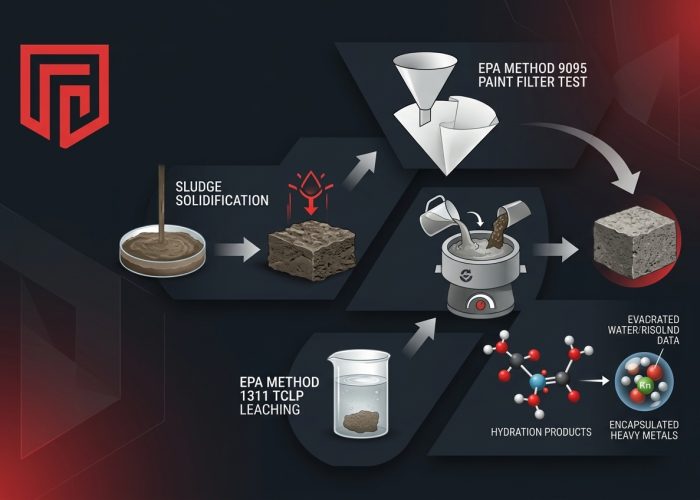
If you’ve ever watched a load of sludge get turned away at the landfill gate, you already know the problem. Most disposal facilities run a paint filter test (EPA Method 9095) on incoming waste, and anything that releases free liquid gets rejected. Solidification — mixing a dry reagent into the waste until it holds together and passes — is how crews get that load accepted. The first question everyone asks is simple: how much cement does it take?
The honest answer is that there’s no universal number. But there are reliable ranges and a repeatable way to find yours.
Why cement is the go-to reagent
Portland cement is the most widely used binder in solidification and stabilization (S/S) work, and for good reason. It reacts with water directly, chemically binding free moisture into hydration products rather than just soaking it up the way a loose absorbent does. On contaminated waste it pulls double duty: it locks up water so the material passes the paint filter test, and it immobilizes many heavy metals by forming insoluble compounds and physically encapsulating them — which helps the treated waste pass leaching tests like TCLP (EPA Method 1311). Type I/II cement is the workhorse here because it’s general-purpose and offers moderate sulfate resistance.
What actually drives the dosage
The amount of cement you need depends far more on the waste than on the cement. The biggest variables are:
- Moisture content. A nearly dry, silty sludge might firm up with a modest addition. A watery slurry needs much more binder to tie up all the free liquid.
- Waste chemistry. Oils, salts, and certain organics interfere with cement hydration and can sharply raise the dose — or call for a pretreatment or a blended reagent.
- Your target. Passing a paint filter test is a lower bar than hitting a specified compressive strength or a TCLP limit. The stricter the spec, the more binder.
- Reagent choice. Straight Portland cement, cement kiln dust, lime, and fly ash all behave differently and are often blended for cost or performance.
Typical ratio ranges
As a planning starting point — not a substitute for testing — cement addition for solidification commonly lands somewhere between roughly 5% and 30% of the waste weight. Thin, wet, or heavily contaminated streams push toward the high end; drier, cleaner material sits near the bottom. Real-world S/S jobs have run the full gamut, from binder-heavy mixes carrying a lot of cement per unit of waste to waste-heavy ones, depending entirely on the material in front of you.
Those numbers are useful for estimating tonnage and truckloads, but never for finalizing a mix. A stream that took 8% last month can take 20% this month if the moisture or contamination changes.
Nail it down with a jar test
The only way to know your real ratio is a bench trial. Take a representative sample, mix in measured percentages of cement — say 5%, 10%, 15%, and 20% — let each set, then run the paint filter test (and TCLP, if leaching is a concern) on the results. The lowest dose that passes reliably, plus a small safety margin, becomes your field ratio. Scaling that up gives you an accurate cement order and keeps you from over-dosing, which wastes reagent, adds disposal weight, and drives up tipping fees.
Buy for consistency, not just price
One factor crews overlook is reagent consistency. If your cement’s fineness or chemistry drifts from load to load, your carefully calibrated ratio drifts with it. Working with an established Portland cement supplier that ships a mill test certificate with every load means the material behaves the same way each time — so the dose you validated in the jar test is the dose that holds up in the field. For solidification crews taking cement by the super sack or bulk tanker, that repeatability is often worth more than a few dollars a ton.
Bottom line
There’s no single magic ratio for solidifying liquid waste. Plan on somewhere in the 5–30% cement-by-weight range, expect wet and contaminated streams to demand more, and always confirm the exact dose with a jar test before committing a full job. Get the reagent and the testing right, and you’ll pass the filter the first time — without paying to haul extra water to the landfill.