
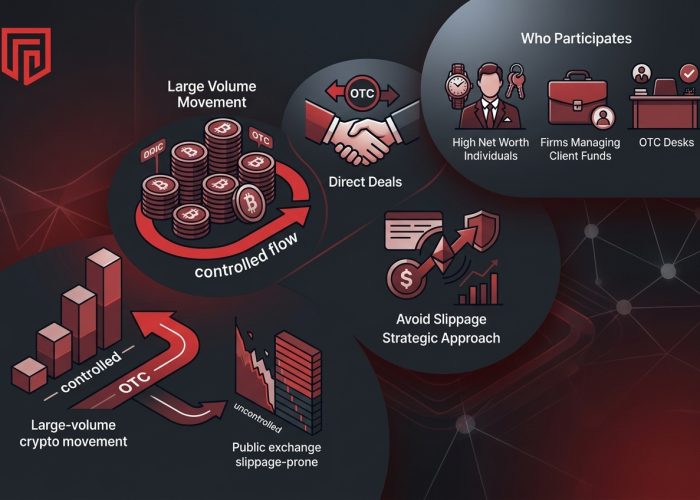
Trying to move large amounts through a public crypto exchange can cause slippage, thin order books, and turn the market against you. But what to do if you need to buy or sell a serious volume of crypto? The answer is OTC desk.
Crypto over-the-counter trading (OTC) means making deals, avoiding public exchanges and order books. That is, buyers and sellers transact directly. Each OTC trade is negotiated privately, and prices and settlement methods are agreed upon. For traders who are scaling or firms managing client funds, OTC offers a more controlled and strategic approach to transact.
How OTC Trading Works
OTC trading means direct agreements between two counterparties, while a specialized desk or a broker is sitting in the middle. Brokers match buyers and sellers depending on the requested trade volume, asset type, and desired price. So there is still a middleman, but not an exchange platform. What is negotiated:
- Prices
- Settlement methods and timelines
- Risk control tools like escrow.
Once the terms are confirmed, the desk or a broker coordinates the transaction. Settlement may be processed via bank, stablecoins, or escrow tools, which depend on jurisdiction and client preferences. Transactions never hit public exchanges, which means no signal for algo traders to hunt for large crypto flows.
For traders working with illiquid altcoins or serious capital in BTC, over-the-counter trading desks reduce slippage and protect entry levels.
Who Uses OTC Desks?
Those can be institutional investors who look for ways to enter and exit the market without shaking the entire market. That may be hedge funds and asset managers, high-net-worth individuals, who also prefer privacy and personalized service. Crypto-native businesses like exchanges and mining companies also use OTC desks to manage treasury efficiently. Even mid-level traders use OTC when public exchanges restrict liquidity.
Types of OTC Platforms
Here are the common types of OTC desks:
- Principal desks. Trade from their own balance sheet, quoting a price and taking the opposite side of your trade. The advantage is fast settlements.
- Agency brokers. Acting as middlemen, they bridge counterparties and earn commission.
- Hybrid desks — may combine principal and agency types depending on volume request.
- Exchange OTC desks — run by major exchanges. They offer private execution while using exchange liquidity pools.
Execution quality is essential for large market players. Large traders demand precision, privacy, deep liquidity, and flexibility. And OTC desks provide it all, without showing your intentions to the broader market. As the market matures, the need for reliable OTC platforms is growing. So understanding how it works is a part of a trader’s professional toolkit.