
The digital nomad lifestyle is as strong as it has ever been despite it being less of a social media hot topic. Remote work isn’t going anywhere, and with the rising cost of living, more and more people seek economic arbitrage of high wages in a cheap country like India or Indonesia, all while broadening their life experiences and cultural interactions. This article looks at three financial tips for such people to help manage their money better.
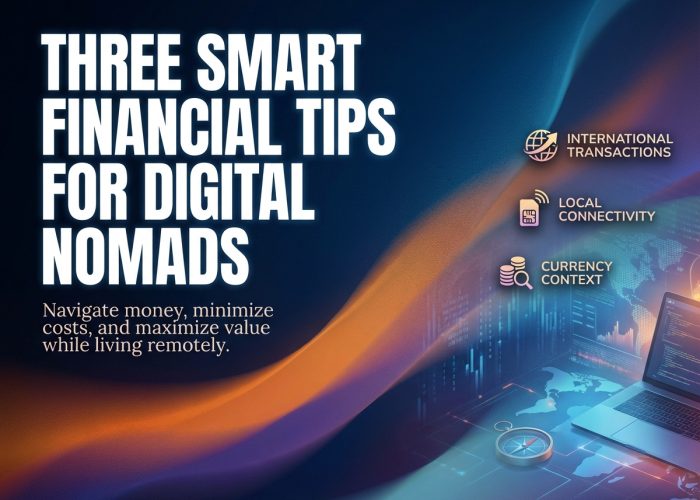
Optimize international transactions
One of the main frictions overseas is moving around different financial systems, particularly when the US and Europe blacklist some nations from international transfers and easy exchanges. For those in South Asia for example, it can be tricky to mange funds between domestic and foreign accounts – you may frequently need to send money from the USA to India, but find fewer options than on your normal travels.
Efficiency and convenience aren’t the same thing, because convenience often has a costly middleman. Using specialized transfer service can be worthwhile rather than traditional wire transfers or simply using your domestic bank card for spending. You may find that single, large transfers are more economical than frequent small ones too. Establishing a consistent transfer pipeline also helps build a verifiable financial footprint in the host country – this may be handy if you eventually decide to apply for long-term residency or a local tax ID.
Choose local SIM cards over eSIMs for better value
Again, convenience is costly, and while eSIMs are tempting, savvy digital nomads know that local options can be much cheaper. And, sometimes, they’re better quality (e.g. better signal). Travel-focused eSIM providers charge a premium for the ease of instant activation, and while it may be worth the money for the first few days (one less thing to worry about), you should try to keep it to a minimum as they’re exponentially more expensive than walking into a local shop. Plus, depending on what number they provide you with, you may not have a legitimate local number, and these are important when signing up to local apps like food delivery or payment services. Just because you’re abroad temporarily, we shouldn’t slack on two factor authentication either.
Research the currency for context
Currency can be particularly wild in developing nations – places where nomads like to hang out, like Argentina, Turkey, and so on. While it’s not recommended to try too hard to be active and clever here, it’s always worth understanding the context of the rates.
Taking the time to identify the best way to send money to India from the USA means not just choosing the right platform, but knowing what state the market is in. At the end of the day, if it’s particularly expensive, you may decide that Sri Lanka or Nepal are only next door and you could get much more for your money on AirBnB. In a few months, things may be different and you could still head to India.
A smart nomad never settles for the first option they see, be it an ATM which may have high fees or a SIM card stand in the airport. If you have a lot on your plate, it can sometimes be worth going with the convenient option, but you have be aware of the difference between paying a premium (airport taxi) and being scammed (airport taxi mafia). We should try limit these convenient options to a minimum, like the settling-in period, before turning to more sensible local options.