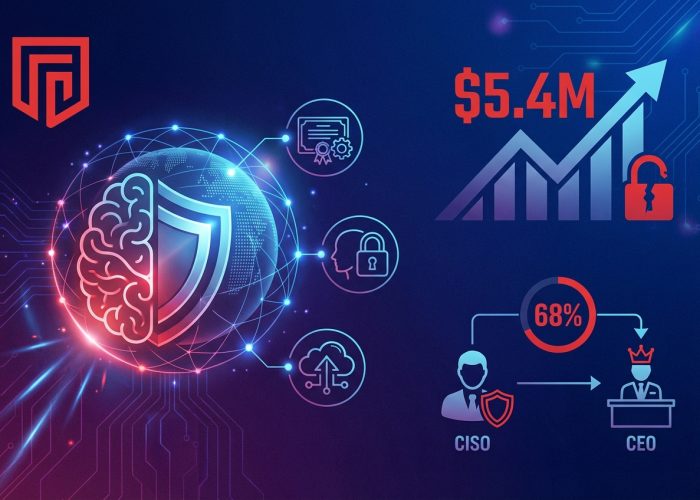
In 2026, the average cost of a data breach has climbed to $5.4 million, forcing boards to prioritize leaders who can translate technical risk into business resilience.
With 68% of enterprise CISOs now reporting directly to the CEO, demand for executives to master cybersecurity leadership programs in 2026 and for CISO executive education has surged.
The programs below are selected to equip leaders with the governance, AI security, and crisis management skills required for this elevated mandate.
How We Selected These Cybersecurity Leadership Programs
- Curriculum focuses on the intersection of technical defense, risk governance, and business strategy
- Inclusion of 2026-critical topics like AI-driven threats, Zero Trust architecture, and SEC disclosure rules
- Strong reputation among global enterprises and top-tier research institutions
- Instruction from sitting CISOs and industry veterans with real-world crisis experience
- Flexible delivery formats (Hybrid/Online) designed for working executives
Overview: Best Cybersecurity & AI Leadership Programs for 2026
| # | Program | Provider | Primary Focus | Delivery | Ideal For |
| 1 | Cybersecurity Leadership | McCombs School of Business at The University of Texas at Austin | Risk & Governance | Online | Risk/Compliance |
| 2 | Intellipaat Cyber Security Course Certification | Intellipaat | Threat Detection & Security | Live Online | Network Security |
| 3 | AI and Cybersecurity: Strategies for Resilience | MIT xPRO | AI Defense & Offense | Live Online | Tech Leaders |
| 4 | AI for Business Leaders | McCombs School of Business at The University of Texas at Austin | ROI & Business Models | Online | General Managers |
| 5 | Executive Master in AI Security | Swiss Cyber Institute | AI Lifecycle Governance | Online | Risk Strategists |
| 6 | AI for Cybersecurity Certificate | Johns Hopkins | Technical AI Defense | Online | Security Engineers |
| 7 | Cybersecurity Strategy and Leadership Accelerator | Cambridge | Crisis Leadership | Online | Global Leaders |
| 8 | Cybersecurity Leadership | Kellogg (Northwestern) | Business Resilience | Online | Managers/Directors |
8 Best Cybersecurity and AI Leadership Programs in 2026
1. Cybersecurity Leadership — McCombs School of Business at The University of Texas at Austin
Overview
In 2026, cybersecurity is no longer just an IT issue but a central pillar of business resilience.
This cybersecurity certificate program equips leaders with the knowledge to manage cyber risk as a strategic variable, covering the intersection of AI-driven threats and defensive governance.
- Delivery & Duration: Online, 20 weeks
- Credentials: Certificate from The McCombs School
- Instructional Quality & Design: Masterclasses on “AI in Cybersecurity” and risk control mapping.
- Support: Mentored learning sessions and industry case studies.
Key Outcomes / Strengths
- Assess the strategic risks posed by AI-enhanced cyber attacks and deepfakes
- Design a “Zero Trust” governance framework for hybrid and remote workforces
- Quantify cyber risk in financial terms for executive decision-making
- Lead incident response simulations to ensure organizational readiness
2. Cyber Security Course & Certification Intellipaat Cyber Security Course Certification
Overview
This online cybersecurity training program from Intellipaat, created in partnership with iHUB DivyaSampark, IIT Roorkee, and EC-Council certified experts, gives learners a complete pathway from foundational concepts to hands-on cybersecurity skills. It’s designed to help beginners and working professionals develop practical skills and industry-relevant experience in cybersecurity.
Delivery & Duration
- Live online instructor-led training over 7 months (60+ live sessions)
- 168 hours of live classes plus self-paced resources and recorded lessons
- Real-world projects and assessments built into the curriculum
Credentials
- Certificate from iHUB DivyaSampark, IIT Roorkee on completion
- Preparation for EC-Council Certified Ethical Hacker (CEH)
Instructional Quality & Design
- Live expert sessions led by industry practitioners and IIT faculty
- 25+ real-world cybersecurity projects covering various threat scenarios
- Curriculum blends basics with advanced topics including ethical hacking, network security, and threat detection tools
Support
- 24×7 learner support and mentoring
- Career guidance including mock interviews, resume building, and placement assistance
- Access to Intellipaat’s job portal and employer network for career opportunities
Key Outcomes / Strengths
- Solid foundational skills: Networking basics, Linux, risk management, cryptography, and system security
- Practical hacking and defence skills: Ethical hacking, vulnerability analysis, malware threats, footprinting,
- Industry tools exposure: Practice with tools like Kali Linux, Wireshark, Nmap, Nessus, Burp Suite, Metasploit and more
- Practical project experience: Complete hands-on assignments and a capstone project simulating real cybersecurity challenges
- Career preparation: Interview prep, resume review, and placement support helps learners move into cybersecurity roles
2. AI and Cybersecurity: Strategies for Resilience and Defense — MIT xPRO
Overview
This specialized program addresses the 2026 mandate for AI security executive education, focusing on both defending against AI-driven attacks and securing internal AI models.
It bridges the gap for technical professionals moving into leadership roles who need to understand the full spectrum of algorithmic warfare.
- Delivery & Duration: Live Online, 4 weeks
- Credentials: Professional Certificate from MIT xPRO
- Instructional Quality & Design: Live sessions with MIT faculty focusing on “Shadow AI” and adversarial machine learning.
- Support: Real-time feedback from industry experts and peers.
Key Outcomes / Strengths
- Architect secure environments that resist AI-enhanced phishing and malware
- Govern the use of “Shadow AI” tools within the enterprise
- Analyze adversarial attacks on machine learning models (data poisoning)
- Draft incident response plans for automated, high-velocity attacks
3. AI for Business Leaders — McCombs School of Business at The University of Texas at Austin
Overview
Designed for non-technical leaders, this ai for leaders program on the “Business of AI,” using frameworks such as the AI Canvas to map high-value opportunities.
It emphasizes the financial realities of deployment, helping executives move from experimental pilots to profit-generating production systems.
- Delivery & Duration: Online, 4 months
- Credentials: Certificate from The McCombs School
- Instructional Quality & Design: Case-based learning focusing on the “AI Canvas” and ROI estimation.
- Support: Live mentorship sessions and global peer networking.
Key Outcomes / Strengths
- Identify revenue-generating use cases using the AI Canvas framework
- Calculate the true ROI of AI projects by factoring in data cleaning and maintenance costs
- Manage the “build vs. buy” decision for generative AI tools and platforms
- Lead cross-functional teams to execute Proof of Concept (POC) initiatives rapidly
Beyond executive education, organizations also need reliable Cybersecurity solutions to strengthen threat monitoring, secure critical infrastructure, and support long-term resilience in an increasingly complex digital landscape.
4. Executive Master in AI Security — Swiss Cyber Institute
Overview
As one of the few dedicated enterprise security governance programs for AI, this master’s track covers the entire lifecycle from board-level governance to red-teaming.
It is essential for leaders tasked with securing their organization’s generative AI deployments.
- Delivery & Duration: Online, 18 months
- Credentials: Executive Master’s Diploma
- Instructional Quality & Design: Blended learning with “AI Lab” challenges to practice defense against model extraction.
- Support: Elite peer network of CISOs and AI risk officers.
Key Outcomes / Strengths
- Architect Zero-Trust pipelines for machine learning operations (MLOps)
- Conduct “Red Team” exercises to test LLM robustness against jailbreaks
- Create Software Bill of Materials (SBOMs) for AI supply chains
- Communicate AI security posture to regulators via data-driven dashboards
5. AI for Cybersecurity Certificate — Johns Hopkins
Overview
Leveraging JHU’s Applied Physics Lab’s expertise, this program offers a rigorous examination of AI threat management for technical leaders.
It moves beyond theory to teach the implementation of AI-driven defense tools, such as anomaly detection and automated malware analysis.
- Delivery & Duration: Online, Self-Paced (approx. 60 hours)
- Credentials: Certificate from Johns Hopkins University
- Instructional Quality & Design: Project-based curriculum where you build tools for spam filtering and intrusion detection.
- Support: Mentorship from JHU engineering faculty.
Key Outcomes / Strengths
- Deploy neural networks to detect polymorphic malware patterns
- Build automated intrusion detection systems (IDS) using machine learning
- Secure internal networks against adversarial AI attacks
- Bridge the gap between data science teams and security operations centers (SOC)
6. Cybersecurity Strategy and Leadership Accelerator — Cambridge
Overview
Targeting a global audience, Cambridge offers a robust view of cybersecurity leadership programs, 2026 governance, and crisis management.
It places heavy emphasis on the geopolitical and ethical aspects of cyber warfare, suited for leaders in multinational environments.
- Delivery & Duration: Online, 8 weeks
- Credentials: Certificate from the University of Cambridge
- Instructional Quality & Design: “Oxbridge” style academic rigor combined with modern industry application.
- Support: Weekly live sessions with tutors and group work.
Key Outcomes / Strengths
- Formulate a cyber resilience framework for cross-border operations
- Understand the role of state actors in the modern threat landscape
- Implement ethical governance for AI and automated security tools
- Manage stakeholder expectations during complex security incidents
7. Cybersecurity Leadership — Kellogg (Northwestern)
Overview
Kellogg applies its business strategy expertise to the cyber domain, focusing on how security enables enterprise resilience.
It helps leaders move their department from a “Department of No” to a strategic enabler of digital transformation.
- Delivery & Duration: Online, 6 weeks
- Credentials: Certificate of Completion from Kellogg
- Instructional Quality & Design: Strategic frameworks to assess organizational maturity and culture.
- Support: Live webinars and dedicated program support.
Key Outcomes / Strengths
- Translate complex cyber threats into business impact statements
- Foster a culture of shared responsibility for security across units
- Develop key performance indicators (KPIs) to measure security effectiveness
- Negotiate for an adequate budget by demonstrating risk reduction ROI
Final Thoughts
In 2026, cybersecurity is no longer just about firewalls; it is about business survival.
Whether you are an engineer looking to harden your code or an executive needing to manage risk, specialized cybersecurity leadership programs in 2026 are the only way to stay ahead.
Selecting the right program will define your ability to protect your organization in an increasingly hostile digital world.