

You want stronger Ad ROAS, and you’re ready to use AI, but picking the right tool still feels like a gamble. Many products promise sharp gains without showing clear proof, and choosing the wrong one can drain budget and time.
The tools you’re comparing work in very different ways. Some tools break down each part of an ad and show which pieces lift results. Others focus on producing fresh assets fast so you can test more ideas. Some tools center on budget moves that cut waste and keep spend focused on ads that hit your goals.
Your task now is to find the option that can show clear, repeatable gains for the ads and spend you handle each day.
In this blog, we’ll look at what AI is doing in ads today, why it matters for ROAS, which tools stand out for 2025, and how to pick the one that fits your goals.
What Is AI Doing in Advertising?
AI is shaping your work in three practical ways you can use right away:
- Faster creative production: Generate and adapt ads in minutes to keep platforms fresh.
- Clear link to outcomes: Tag creative parts and see what actually drives installs or sales.
- Always-on optimization: Shift spend to winners and automatically pause weak ads.
Together, these actions shorten the gap between insight and action, helping your strongest ads scale faster while stopping poor performers before they drain your budget.
Why Is AI Essential for Improving ROAS?
Paid media moves fast, and manual optimization misses signals that affect performance. AI reads far more data points, audience shifts, auction changes, creative patterns, and reacts instantly. That keeps spend on what’s actually driving results.
Independent testing of Google’s AI-powered Demand Gen and Performance Max showed 8–15% higher ROAS compared to non-AI setups. And with around 88% of marketing teams already using AI daily, these gains are becoming standard across competitors.
With measurable lifts and wide adoption, AI is now a core driver of stronger returns, especially when matched with tools built for performance outcomes.
Top AI Tools to Watch in 2025
With budgets under pressure and competition high, the right tools can make a clear difference. These picks deliver better insights, sharper creative decisions, and smoother workflows for stronger ROAS in 2025:
1. Segwise
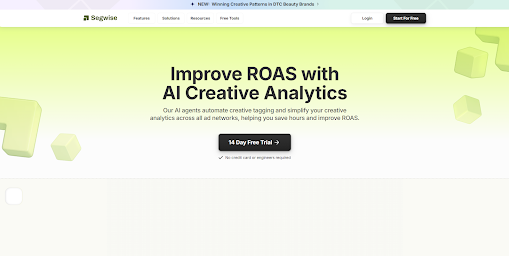
Segwise is an AI-first creative analytics platform that links specific creative elements, hooks, dialogues, headlines, characters, influencer traits, CTAs, and audio cues directly to outcomes like installs, ROAS, CPA, and LTV. By pulling data from major ad networks and using multimodal AI tagging it reveals which parts of an asset drive results.
This clear mapping of elements to KPIs makes Segwise a strong choice for anyone who needs proof of what actually drives growth.
Key features:
- Multimodal Auto-Tagging: Auto-detects and tags variables such as visuals, scenes, text, and audio cues so you can quickly analyze element-level impact.
- Cross-Network Data Joins: Unifies creative and performance data from Meta, Google, TikTok, major DSPs, and MMPs for apples-to-apples comparison.
- Creative Fatigue & Alerts: Flags declining creative performance early so you can rotate assets before costs rise.
- Project/Studio Views: Roll up insights by app, brand, or campaign to prioritize where to reallocate spend.
- AI Creative Generation: Produces new variations grounded in performance signals from your campaigns. Its tagging and analytics agents identify the elements that drive ROAS, CPA, and conversion rates, then guide the next set of workable angles.
Best for:
If you lead app user growth or run creative-driven acquisition, Segwise helps you prove which ad parts move value and cut waste. In 2–3 weeks of testing, you can start using tag-level signals to prioritize high-ROI creatives across platforms.
Pros:
- Direct link to revenue metrics: Shows which creative elements raise installs and LTV, so your scaling decisions target returns, not impressions.
- Faster winner identification: Auto-tagging plus cross-network joins reduce time to statistical signals, lowering wasted spend.
- Prevents ROAS decline: Fatigue tracking helps you refresh assets before performance drops, raising CPA.
- Prioritizes high-impact tests: Data-backed briefs focus production on iterations most likely to improve ROAS.
Cons:
- Adds deep insight that may be more than you need for a single short test.
- Requires brief alignment on creative naming and input to achieve the best tagging accuracy.
- Best value shows up as you scale many creatives or run many campaigns.
Pricing:
Free trial available; paid plans scale with usage and integrations. Contact sales for custom enterprise pricing.
2. AdCreative.ai
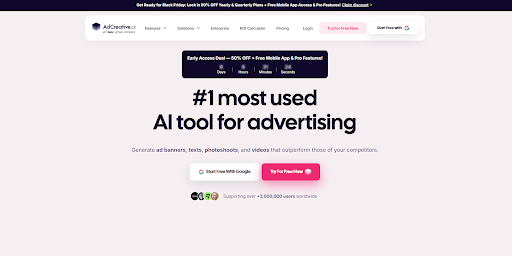
AdCreative.ai creates banners, short videos, and ad copy using models trained on conversion signals. It generates rapid creative variations with easy performance scores for faster testing. Templates, brand controls, and predictive scoring help teams keep creative volume high and improve ROAS.
Key features:
- Rapid generation for multiple ad formats and templates.
- Built-in performance scoring and on-brand customization.
Best for:
Choose this if your priority is producing many on-brand assets fast and running lightweight A/Bs, not for deep element-to-KPI studies.
Pros:
- Speeds up creative production and initial tests.
- Simple UI and conversion-focused templates.
Cons:
- Lacks robust element-level linking of creative parts to long-term KPIs.
- Generated assets still need human review for brand fit and platform rules.
- Performance scoring is broad and not a substitute for full cross-network measurement.
Pricing:
Multiple tiers and trials; check their site for current plans and limits.
3. Madgicx
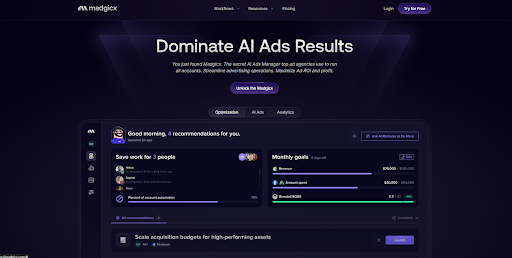
Madgicx acts as an AI media assistant, offering bidding, account audits, and scaling tools. It automates budget moves, reduces wasted spend, and can boost ROAS by improving campaign efficiency, though it doesn’t reveal which creative elements drive results.
Key features:
- AI-driven campaign automation and bidding.
- Creative optimization signals and account audits.
Best for:
This fits if you want automated budget and bid management with some creative support, but it is less useful if you need element-level creative causality.
Pros:
- Reduces daily optimization tasks and automates scaling.
- Helpful account audits and recommended actions.
Cons:
- Not focused on tagging every creative element and mapping it to long-term value.
- Automation can hide why a change worked unless you layer in creative analytics.
- Pricing and features scale with spend; account complexity may increase setup time.
Pricing:
Free trial available; tiered plans that reflect features and spend managed.
4. VidMob
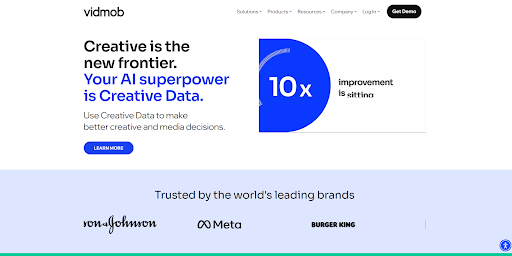
VidMob combines creative analytics with an on-demand production studio, scoring ads by visual, audio, and messaging signals and turning those insights into new, platform-ready creatives.
Key features:
- Labels scenes, text, and audio, and surfaces recurring patterns tied to performance.
- On-demand production and project management so teams can quickly turn insights into new ad variations and publish them directly to ad accounts.
- Extracts tag-level data and scores for use in dashboards, MMM, or attribution stacks.
Best for:
Teams that need faster, production-led testing and surface-level creative signals rather than precise tag-to-metric causality.
Pros:
- Speeds the loop from insight to published ad.
- Practical creative scores that help prioritize edits.
- Works well with existing ad workflows and asset pipelines.
Cons:
- Enterprise pricing and onboarding can be steep for small teams.
- Production-first focus can push quick iterations that amplify correlation (not always causation), leading to noisy winners.
- Does not provide the deep tag-level element→KPI causal mapping some creative analytics platforms offer (the specialty many acquisition-focused teams look for).
Pricing:
Enterprise-oriented plans; contact sales for quotes and trial options.
5. Predis.ai
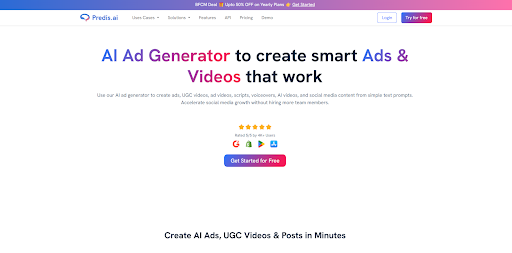
Predis.ai is an AI tool for rapid creative generation, resizing, and content scheduling. By speeding up asset creation and recycling, it boosts testing throughput, enabling fresher variations that can indirectly enhance ROAS.
Key features:
- Fast generation, multi-format resizing, and scheduling.
- Support for multiple languages and simple social workflows.
Best for:
Use this when you need lots of creative variations fast and a simple content pipeline, not when you need deep attribution of creative elements to long-term value.
Pros:
- Low-cost entry and fast turnaround for many formats.
- Good for repurposing assets across platforms.
Cons:
- Does not provide element-level KPI mapping that ties specific visuals/lines to ROAS.
- Generated outputs often need editing to align with brand tone and policies.
- Advanced analytics and cross-network joins are limited compared with creative analytics platforms.
Pricing:
Entry tiers start low (examples shown at $19–$40/month); team and enterprise plans available. Confirm current plans on their site.
Since each tool improves results in its own way, the final step is choosing the one that fits your goals and your workflow. A simple approach can help you make a quick decision.
How to Select the Right Tool for Your Business
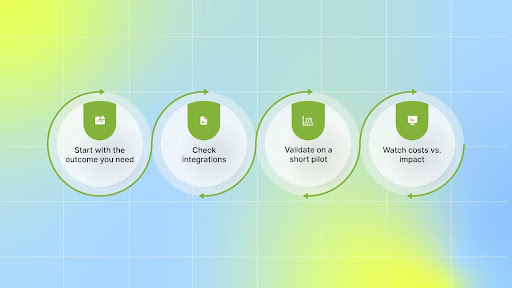
Choosing the right AI tool becomes easier when you focus on what truly supports your daily work. A simple path helps you narrow the options fast and make a choice that lifts results without adding stress:
- Start with the outcome you need: If you want quicker content, choose creation tools. If improving conversion is the goal, choose creative analysis. For repetitive tasks, look at automation and optimization.
- Check integrations: Ensure the tool integrates smoothly with your ad platforms and analytics tools. Strong integrations eliminate manual work and provide clearer insights from the start.
- Validate on a short pilot: Run a short pilot to see if the guidance actually improves results. Track metrics like ROAS or revenue lift and compare with your usual workflow.
- Watch costs vs. impact: Review pricing against clear gains such as time saved and fewer wasted tests. Watch for setup or data mapping fees so you get a full picture before committing.
With these steps in place, you can sort through tools with clarity and pick one that fits your goals, your setup, and your budget, giving you a smoother path to stronger ROAS.
Conclusion
Choose tools that give you quick, verifiable signals you can act on, turn creative findings into focused tests, and connect your ad and measurement data so decisions happen sooner. Short pilots and data-backed creative cues help you scale what works and cut what doesn’t, keeping more of your budget tied to real revenue lifts.