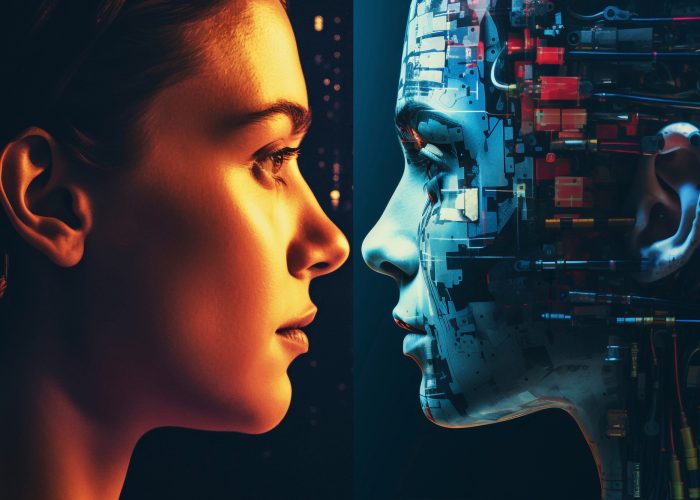

The potential for artificial intelligence (AI) to completely reshape the world is becoming clearer every year. In 2025, the integration of AI into society has increased dramatically, particularly in the workplace. As per the latest data, 78% of global companies are reportedly using AI in their business, and 92% of companies plan to increase their investment in AI over the next three years.
While a lot of positives are emerging from this rapid integration, there is still a concern over how AI is getting closer to overtaking human intelligence as AI companies look to make the technology more human-like. In a previous post on the Benefits of Humanizing AI Text, we outlined how AI text can follow a conversational flow, understand emotional context, and adapt to the preferences of your audience. The ability for AI to mimic human behaviour and output is not just down to the data that the AI model is trained on, but how closely AI and human intelligence overlap in some areas. Below are 3 ways human intelligence and AI are similar.
How We Store and Process Information
One of the key arguments on how AI will never be able to replicate human intelligence is because of how complex the brain is. Humans think, act, and make decisions based on their past experiences and memories, deriving patterns based on their surroundings and situations. A human gets their information from what they read, observe, and listen to, which then forms patterns, saves memories, and allows for the comprehension of new situations based on previous experience. MongoDB’s detailed guide to AI explains that it works in the same way. As per the guide: “When a computer is fed with enough data, it is capable of deriving certain outcomes, based on the data patterns, through algorithms”. Like a human brain, the AI retrieves information and uses it to find patterns, self-learn, and comprehend new situations based on previous data and patterns.
Understanding Context
The ability to understand context and nuance is, to many, the difference between human intelligence and AI, and yet this ability is another area where there is starting to be an overlap. Live Science reports how MIT AI researchers have developed a new method to help artificial intelligence systems conduct complex reasoning tasks. They have achieved this by creating “a treasure trove” of natural language “abstractions” for chatbots that turn complex subjects into high-level characterizations and omit unimportant information. This allows chatbots to “reason, learn, perceive, and represent knowledge just like humans”. Another way AI can understand context is through semantic searches, which find meaning in the input queries even if the exact keywords are not present. This mimics human understanding of language and context and allows the AI to provide more accurate and relevant results.
Cognitive Bias
Human decision-making is steeped in cognitive bias, as the brain needs to simplify complex information and make quick decisions. In humans, this bias is often a result of emotional influences and social and cultural factors. Researchers have found evidence that this is another way AI overlaps with human intelligence. A paper on Exploring Similarities in Cognitive Bias in artificial intelligence and human decision making found that Artificial Personas (APs) produced by Large Language Models (LLMs), like ChatGPT, can exhibit cognitive biases like those observed in human decision-making. Just as humans are influenced by social and cultural bias, AI can be influenced by the data they are trained on and automatically form a bias. However, unlike human intelligence, which can deliberately form a bias, AI does so not out of emotional and cultural influence but because that bias is already present in the data it has been trained on.
While there is a clear divide between human intelligence and AI, it is also clear that there is much more of an overlap than is initially obvious. As AI continues to develop and become integrated into modern society, these overlaps will increase, and AI will show more similarities with human intelligence.