
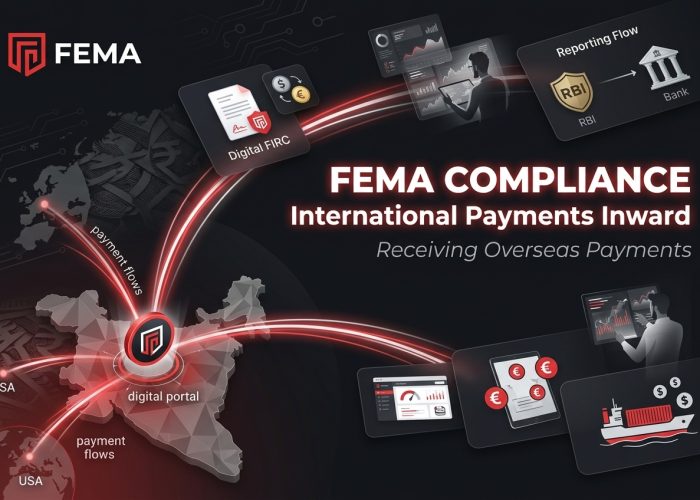
If you are an Indian business receiving payments from overseas customers, FEMA compliance is not optional. The Foreign Exchange Management Act, 1999, governs how foreign currency enters and leaves India, and the RBI sets the rules. Whether you are a SaaS startup billing US clients, a freelancer working with European studios, or an exporter shipping goods abroad, your foreign inflows are tracked, reported, and must be backed by proper documentation.
Here is what you actually need to know to stay compliant without drowning in jargon.
What FEMA applies to
FEMA applies to any cross-border transaction involving an Indian resident. For inbound payments, the relevant categories are:
- Software exports (SaaS, IT services, consulting)
- Goods exports
- Royalties and licensing
- Freelance and professional services
- Foreign investments and capital flows
If your business falls into any of these and you are receiving USD, EUR, GBP, AED, SGD, or other foreign currencies, FEMA rules apply.
Documents you must collect for every inflow
FIRC or FIRA
A Foreign Inward Remittance Certificate (FIRC) or Foreign Inward Remittance Advice (FIRA) is issued by your bank or your payment gateway provider once an international payment is credited. This document proves the foreign currency entered India through legal channels.
FIRCs are mandatory for:
- Claiming export incentives
- GST refunds on exports
- Income tax filings to prove export income
- Foreign investment audits
A reliable international payment gateway will auto-generate FIRC or FIRA documents for every transaction and store them in your dashboard.
Purpose code
Every foreign inflow must be tagged with an RBI-defined purpose code. Common codes include:
- P0802: Software consultancy and implementation
- P0103: Export of goods
- P1006: Business and management consultancy
- P0207: Travel and tourism
Tagging the wrong code can trigger queries from your AD bank. Most international payment gateways prompt you to select the right code at onboarding or per transaction.
Invoice and contract
Maintain a signed invoice and ideally an agreement or PO with the overseas client. RBI can ask for this in case of audit or scrutiny.
EEFC accounts
An Exchange Earners Foreign Currency (EEFC) account lets you hold up to 100 percent of your foreign earnings in foreign currency without immediate conversion to INR. This is useful if you have foreign currency outflows (overseas SaaS subscriptions, foreign hires, international suppliers) and want to avoid double FX conversion.
EEFC accounts must be opened with an authorised dealer (AD) bank. Funds in the account can be used freely for permitted purposes but must be converted to INR at the end of the month they enter (with rolling exceptions).
Timeline rules you cannot miss
For software and service exports, FEMA mandates that payment must be realised within 9 months from the date of invoice. For goods exports, it is also 9 months. If the customer delays beyond this, you must file a Softex form or an extension request with the RBI.
For SaaS companies running annual contracts billed upfront, this is rarely an issue. For those billing on milestones or on net 60 to net 90 terms, build internal alerts.
GST and FEMA work together
Service exports are zero-rated under GST, but only if:
- The supplier is located in India
- The recipient is located outside India
- The payment is received in convertible foreign exchange
- The place of supply is outside India
- The supplier and recipient are not merely establishments of the same entity
Your FIRC proves the third condition. Without it, GST exemption is at risk.
Common mistakes
- Receiving via informal channels like personal PayPal accounts not linked to AD banks
- Mixing personal and business inflows in the same bank account
- Failing to collect FIRC for smaller transactions because they seem too small to bother with
- Wrong purpose code selection
- Not maintaining contracts for digital services
- Missing the 9-month realisation deadline on net-term invoices
Choosing the right partner
A FEMA-compliant international payment gateway should provide:
- Automated FIRC/FIRA generation
- Purpose code mapping at onboarding
- Settlement in INR (or to an EEFC account if you have one)
- Support for 100 plus currencies
- AD bank tie-ups with major Indian banks
- Audit-ready transaction reports
FEMA compliance is mostly about documentation discipline. Once you have a partner that handles the paperwork automatically, the rest is just keeping your invoicing clean.