
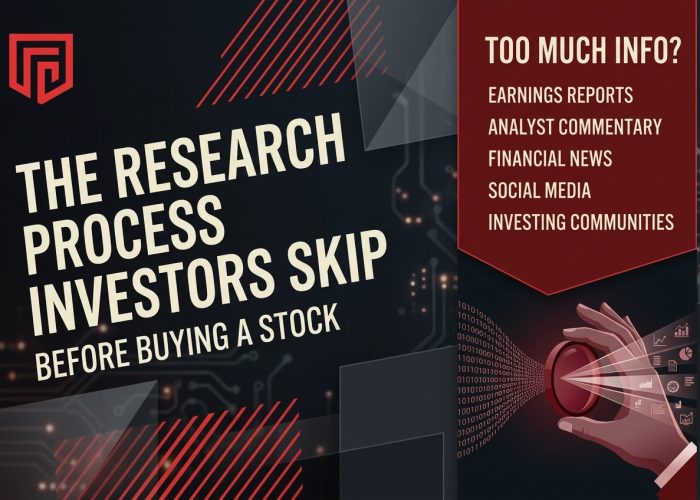
The stock market offers investors more access to information than at any point in history. Earnings reports, analyst commentary, financial news, social media, podcasts, and investing communities provide a constant flow of ideas and opinions. While this abundance of information can be valuable, it has also encouraged a habit that often leads to poor investment decisions: buying stocks before completing meaningful research.
Many investors hear about a company, notice recent price momentum, and move directly toward a purchase without fully understanding what they are buying. This approach may occasionally produce positive results, particularly during strong market environments, but it can also expose investors to unnecessary risks. Successful investing rarely depends on acting first. More often, it depends on understanding the business, evaluating the opportunity objectively, and making decisions based on evidence rather than excitement. The research process may not receive as much attention as stock picks and market forecasts, but it often plays a larger role in long-term performance.
Understanding the Business Before Looking at the Stock
One of the most important steps in investment research is understanding the underlying business. Surprisingly, this is also one of the steps many investors skip. They spend time studying price charts, reading predictions, or following online discussions without first developing a clear understanding of how the company actually operates.
A strong research process begins with basic questions. How does the company generate revenue? Who are its customers? What makes it different from competitors? What risks could affect future growth? These questions provide context that cannot be found by looking at stock prices alone. Without this foundation, investors often find themselves owning shares in businesses they struggle to explain or evaluate.
Understanding the business also helps investors remain confident during periods of market volatility. When someone understands how a company creates value, short-term price movements become easier to evaluate within a broader perspective. Instead of reacting emotionally to every market fluctuation, they can focus on whether the underlying business continues to perform as expected.
Creating a Structured Research Process
Many investors collect information but lack a consistent framework for turning that information into decisions. As a result, every stock may be evaluated differently, leading to inconsistent conclusions and emotionally driven choices. A structured process helps create discipline by ensuring the same factors are considered every time an investment opportunity appears.
This often includes evaluating financial strength, growth potential, valuation, competitive advantages, industry trends, and overall risk. By following a repeatable process, investors can compare opportunities more effectively and reduce the influence of market excitement. Investors who want to organize these factors more systematically often explore tools associated with best stock analysis software as part of building a research framework that supports consistent decision-making.
The purpose of structure is not to guarantee successful investments. Markets will always contain uncertainty. Instead, a structured approach helps ensure that decisions are based on relevant information rather than assumptions, headlines, or temporary market sentiment.
Looking Beyond Headlines and Popular Opinion
Financial headlines often focus on dramatic events because those stories attract attention. Earnings surprises, market selloffs, executive changes, and product announcements frequently dominate the news cycle. While these developments can be important, they rarely provide enough information to support a complete investment decision.
Investors who rely primarily on headlines may find themselves reacting to short-term events without understanding broader trends. Popular opinion can create similar problems. When a stock receives widespread attention, many people assume the opportunity has already been validated simply because others appear enthusiastic about it. However, popularity does not eliminate risk, nor does it guarantee future returns.
Independent research allows investors to examine opportunities from multiple perspectives. It encourages them to challenge assumptions, identify potential weaknesses, and evaluate whether a company’s prospects justify its current valuation. This process often reveals details that receive far less attention than the latest market narrative but may have a greater impact on long-term performance.
Financial Statements Reveal What Headlines Cannot
Photo by Aidan Hancock on Unsplash
A company’s financial statements often provide some of the most valuable information available to investors. Revenue growth, profitability, debt levels, operating margins, cash flow, and capital allocation decisions can reveal strengths and weaknesses that may not be obvious from media coverage or stock performance alone.
Investors do not need advanced accounting expertise to benefit from reviewing financial information. Even a basic understanding of key metrics can help identify trends that influence future performance. Strong revenue growth accompanied by declining profitability may suggest one story, while steady cash flow and improving margins may suggest another. These details often provide context that is difficult to obtain elsewhere.
Reviewing financial statements also helps investors identify warning signs before they become major problems. A company may appear successful from the outside while experiencing underlying financial challenges that eventually affect its ability to grow. Understanding these indicators allows investors to make decisions based on business performance rather than market perception alone.
Comparing Opportunities Instead of Evaluating Stocks in Isolation
One mistake many investors make is becoming focused on a single company without considering alternative opportunities. Even if a stock appears attractive, it should still be evaluated against other available investments. Every position added to a portfolio represents a decision not to invest somewhere else.
Comparative analysis helps investors think about opportunity cost. A company with strong growth prospects may still be less attractive than another company offering better valuation, stronger competitive advantages, lower risk, or a more favorable industry outlook. Looking at multiple opportunities side by side often produces more balanced decisions than evaluating a single stock in isolation.
This approach also reduces emotional attachment to individual investment ideas. Investors who compare alternatives regularly are often more willing to adjust their views when new information becomes available. Instead of searching for reasons to justify a particular stock purchase, they focus on identifying the strongest opportunities available at a given time.
Understanding Risk Before Chasing Returns
Potential returns naturally attract attention, but risk deserves equal consideration. Many investors spend significant time estimating how much money they could make while devoting far less attention to what could go wrong. This imbalance can lead to unrealistic expectations and unnecessary exposure to avoidable risks.
Every investment carries uncertainty. Economic slowdowns, competitive threats, regulatory changes, technological disruption, shifts in consumer behavior, and management decisions can all influence future performance. Understanding these possibilities before investing helps create a more balanced assessment of the opportunity.
Considering risk does not require pessimism. Instead, it encourages preparation. Investors who evaluate both positive and negative scenarios are often better equipped to manage market volatility and make rational decisions when conditions change. A realistic understanding of risk helps prevent surprises from becoming crises.
Better Research Leads to Better Decisions
No research process can eliminate uncertainty from investing. Markets are influenced by countless factors, many of which cannot be predicted with precision. However, investors who take the time to understand businesses, evaluate financial performance, compare alternatives, assess risk, and follow a structured decision-making process generally place themselves in a stronger position than those who rely primarily on headlines or market excitement.
The value of research is not that it guarantees success. Its value lies in improving the quality of decisions. Over time, consistently making better decisions can have a significant impact on investment outcomes. While no one can predict every market movement, investors who commit to a disciplined research process often find themselves navigating uncertainty with greater confidence and clarity.