

Artificial intelligence (AI) is transforming competitive landscapes across diverse industries. From emerging startups to established multinational corporations, the pervasive influence of AI enhances efficiency and sparks innovation.
A recent McKinsey Global Survey shows that 65% of organizations now regularly use generative AI, a significant increase from just ten months ago. This quick adoption underscores AI’s essential role in reshaping business operations and strategies. As AI technology evolves, businesses must decide whether to adopt AI to leverage its benefits or risk lagging in a dynamic market. Let’s explore how companies are utilizing AI to maintain their industry lead.

AI at the Core of Business Transformation
Integrating AI into business strategies is now essential, not just an option, as it forms a central element of digital transformation. Many professionals exploring this shift also participate in the best AI community to understand how AI is being applied across real-world business transformation strategies.
Companies utilize AI to enhance a range of operations, from supply chain logistics to instantaneous decision-making.
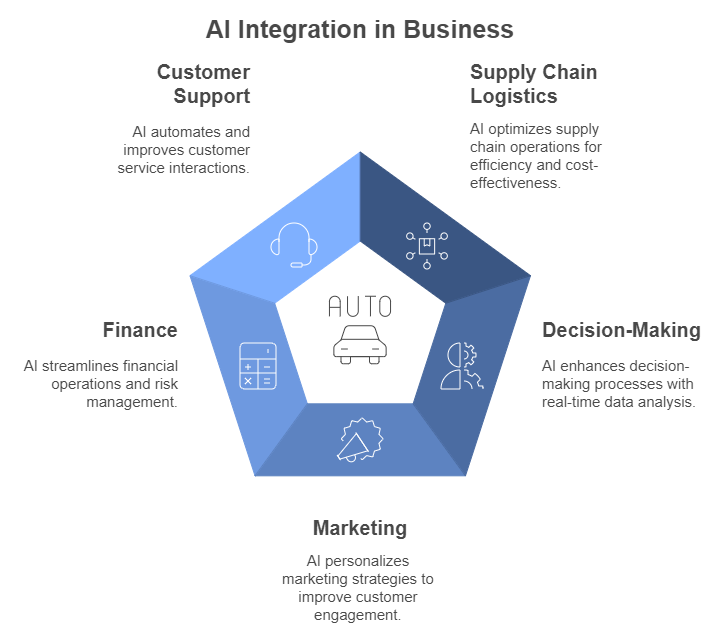
AI-powered tools and applications aim to streamline processes, automate tasks, and improve outcomes across multiple departments, including marketing, finance, production, and customer support. It is evident that enterprise AI applications are crucial in businesses; they simplify complex processes, enable real-time analytics, and unlock new opportunities that were previously inaccessible. These advancements highlight the essential role AI plays in helping businesses enhance productivity and maintain a competitive edge.
Enhancing Customer Experience
AI significantly refines how companies engage with their customers. By using tools like chatbots and AI-driven recommendation systems, businesses deliver personalized experiences efficiently and on a large scale. These systems scrutinize customer behavioral patterns, enabling businesses to predict and meet customer needs and preferences proactively. For instance, top recruiting apps leverage AI to match job seekers with roles that align with their skills and experiences, improving the recruitment process’s precision and speed. These technologies manage inquiries and support requests continuously while also anticipating customer needs in advance. This approach results in more engaging and fulfilling customer interactions that foster loyalty and boost retention rates. Businesses that successfully incorporate AI into customer service typically see tangible improvements in customer satisfaction and loyalty, as well as increased long-term value, with many relying on insights from ai customer service companies to select the right solutions.
Streamlining Operations with Automation
Automation is one of AI’s greatest strengths. It replaces time-consuming manual work with reliable and error-proof automation systems that run tirelessly without fail, saving both time and costs while eliminating human error to enhance operational efficiency. In sectors like manufacturing, voice AI-driven robots perform intricate assembly line tasks with precision and speed, surpassing human capabilities.
AI in logistics helps optimize routes and inventory levels without human intervention, cutting costs while improving delivery times. With the support of professional AI development services, businesses can harness tailored solutions that extend across virtually every industry imaginable, providing innovations that increase productivity at every level of operation.
Data-Driven Decision-Making
AI allows businesses to quickly process and analyze massive amounts of data to make informed decisions quickly, giving executives an edge in recognizing trends, making predictions, and responding swiftly to market changes.
Utilizing predictive analytics and real-time data from sources like AI-powered feeds enables businesses to gain actionable insights, allowing for strategic adjustments and smarter decision-making based on accurate information. As data volumes continue to expand exponentially so will AI’s role in data-driven decision-making, giving businesses an advantage in handling potentially chaotic market conditions.
Innovating Products and Services
AI is instrumental in product development and service improvements. It allows companies to experiment with and modify new products through virtual simulations, lowering the time and costs associated with traditional research and development. These simulations help businesses perfect prototypes and tailor features to align more closely with customer expectations. In entertainment and app development, utilizing a Magic Hour AI face swap allows developers to test and preview visual user experiences before rolling them out to the public.
Furthermore, AI’s capacity for prediction allows companies to refine their services to align with consumer preferences, thereby enhancing client satisfaction and propelling continual innovation. Using AI-driven insights, enterprises can identify unaddressed customer desires, recalibrate their service offerings, and hasten the rollout of new products, thereby solidifying their market standing.
AI in Risk Management and Security
Within the domains of finance and cybersecurity, the capacity of AI to discern patterns and anticipate potential hazards is critically advantageous. Banks and financial bodies deploy AI to detect anomalies indicative of fraud and evaluate risks with immediacy, thus fortifying their security frameworks effectively and efficiently. AI algorithms scrutinize transaction patterns and behaviors to flag atypical actions, substantially mitigating the possibility of fraud before its advancement.
Likewise, cybersecurity entities apply AI to pinpoint weaknesses and counteract threats with unprecedented speed, safeguarding vital information from intricate threats. Employing AI in these domains not only strengthens protections but also reinforces trust among stakeholders, as it allows enterprises to guard critical data diligently.

Challenges and Ethical Considerations
Despite its manifold benefits, the deployment of AI brings about substantial challenges for businesses. The significant expenditure involved with AI technologies and data privacy issues presents considerable barriers.
For smaller firms, the initial financial commitment to AI is formidable, though it generally yields substantial benefits in operational efficiency and decision-making over time. Additionally, the repercussions of AI on employment and ethical dilemmas related to its deployment necessitate thoughtful handling and oversight. Businesses are compelled to confront these challenges with transparency and responsibility to harness the full capabilities of AI.
Establishing ethical guidelines and listening to employee concerns are crucial steps toward creating an ostensibly seamless integration and an affirmative outlook toward AI use in the workplace.
Conclusion
AI is revolutionizing business operations, opening unrivaled opportunities for growth and innovation. As AI becomes more accessible to companies, they should strategically implement it to enhance their functions and maintain a competitive edge. From improving interactions with customers to streamlining operations or safeguarding data, AI stands ready to disrupt all facets of the enterprise by investing in and harnessing its immense potential.