A consistent brand gives customers a clear idea of what to expect across every interaction, from a website visit or social post to a conversation with a sales or customer service team. As businesses add more teams, locations, and channels, keeping those experiences aligned becomes harder.
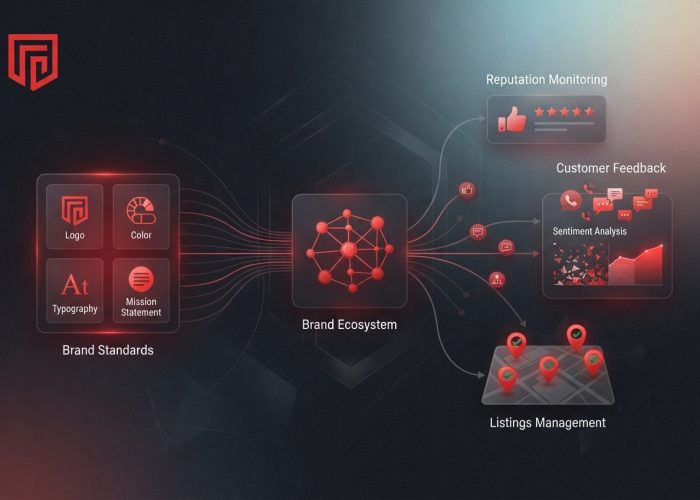
Brand management software can help by organizing brand standards, consolidating customer signals, and helping teams identify where the experience may differ from the intended brand promise.
Depending on the platform, capabilities can include brand health tracking, customer feedback, reputation monitoring, reviews, listings, and sentiment analysis.
What Does Brand Consistency Mean for a Business?
Brand consistency means maintaining the same core identity and expectations across customer touchpoints.
That includes brand presentation, such as messaging, tone, and visual identity, and brand experience, which reflects how customers actually interact with the business. The two need to work together.
For example, a company may consistently communicate that it provides fast service. If customers regularly encounter slow responses, the experience does not support the message.
Brand guidelines can help teams maintain a unified identity by defining how visual and written brand elements should be used.
Why Does Brand Consistency Become Harder as Businesses Grow?
As businesses grow, more teams, locations, and customer touchpoints can make brand consistency harder to manage.
- More teams: Marketing, sales, service, and operations can each shape the customer experience.
- Fragmented data: Customer information spread across systems can make it harder to see the full experience.
- More locations: Different sites may deliver different customer experiences.
- More touchpoints: Websites, reviews, social media, and support interactions all influence brand perception.
This makes consistency an ongoing process rather than a one-time branding exercise.
How Does Brand Management Software Maintain Consistency?
Brand management software can support consistency through four connected functions.
- Centralizing brand standards: Depending on the platform, teams can access brand guidelines, approved resources, and other standards from a shared system. This gives employees a common reference when creating or managing customer-facing materials.
- Standardizing workflows: Some platforms provide processes for reviewing, approving, and updating brand-related content. This can reduce variation caused by different teams following different processes.
- Monitoring customer experience: Broader brand management platforms can connect customer feedback, reviews, reputation data, digital experiences, and sentiment with brand measurement.
- Identifying brand gaps: When these signals can be reviewed together, teams can investigate differences between the experience they intend to deliver and what customers report.
The process can be viewed simply as:
Brand promise → customer experience → feedback → identified gap → action.
How Can Customer Feedback Reveal Brand Gaps?
Brand guidelines tell employees how a business should communicate. Customer feedback can show whether the resulting experience matches that intent.
Consider a business that positions itself around convenience. Its website and advertising may communicate that message consistently, while customer feedback reveals difficulties with ordering or response times.
That difference matters because customer interactions, not communication alone, shape brand perception. The American Marketing Association notes that brand delivery across channels contributes to consistency of the overall experience.
Customer feedback platforms can also bring signals from surveys, reviews, support interactions, and digital experiences into a more connected view.
How Can Software Support Multi-Location Brands?
Multi-location businesses need central brand standards while still being able to see what happens at individual sites.
Location-level reporting can help teams compare feedback, reviews, sentiment, and other customer signals between locations. Alchemer’s platform is designed to connect brand health with location- and product-level signals.
The objective is not to make every location identical. Local teams may need to adapt to their markets. The objective is to identify differences that could affect the broader brand experience.
How Can Businesses Measure Brand Consistency?
Businesses can use several indicators to understand how customers perceive and experience the brand, including:
- Brand awareness
- Brand perception
- Brand consideration
- Customer sentiment
- Customer satisfaction
- Review trends
- Customer feedback
- Customer loyalty
- Location-level differences
Alchemer identifies awareness, perception, consideration, and loyalty as four dimensions of brand management and connects these measures with operational signals such as reviews, listings, social activity, and digital feedback.
Looking at multiple signals provides more context than relying on one metric.
What Should Businesses Look For in Brand Management Software?
Businesses should evaluate software based on their operating model, customer touchpoints, and reporting requirements.
Key questions include:
- Can teams manage current brand standards?
- Can the platform collect customer feedback?
- Can it monitor reviews and reputation?
- Can teams compare locations or channels?
- Can it measure changes in brand perception?
- Can insights reach the teams responsible for taking action?
The right solution should connect brand standards with customer experience and measurable outcomes, rather than simply storing brand assets.
Conclusion
Brand consistency is an ongoing process. Businesses need to keep brand standards aligned while monitoring how customers actually experience and perceive the brand.
The value of brand management software is therefore not limited to keeping brand assets consistent. It can help businesses connect brand standards, customer feedback, reputation, experience data, and measurement so teams can identify gaps between the brand promise and the customer experience and respond to them.