
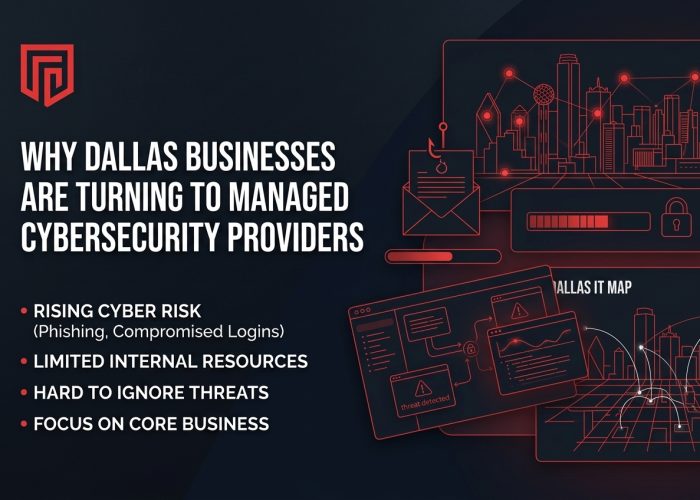
More Dallas-area business owners are hiring a managed cybersecurity provider for Dallas businesses than they were a few years ago, and it’s not because they suddenly got more interested in technology. It’s because the risk got harder to ignore. A single phishing email or a compromised login can now shut down a small company for days, and most owners running a 15-person firm don’t have the time or staff to watch for that kind of thing on their own.
Why local businesses are being targeted more
Attackers have realized that small and mid-size businesses are often easier targets than large enterprises. A Dallas manufacturing shop or a two-office law firm typically doesn’t have a dedicated security team, and it usually doesn’t have the layered defenses a bigger company can afford. That combination makes local businesses attractive, not because they have more valuable data, but because they’re less prepared to catch an attack before it does damage.
Artificial intelligence has made this worse. Attackers now use AI tools to write more convincing phishing emails, clone voices for phone scams, and generate fake invoices that look exactly like the real thing. A 2026 Sagiss survey on AI-driven phishing found that a large majority of employees now believe AI has made phishing attempts noticeably harder to spot compared to a few years ago, and that shift is exactly why more DFW businesses are looking for outside help instead of relying on general IT support to catch everything.
What a managed cybersecurity provider actually does
The day-to-day work is less dramatic than most people expect. It’s mostly prevention and monitoring, not firefighting. A provider typically watches a business’s network and devices around the clock, looking for unusual activity such as a login from an unfamiliar location or a device suddenly trying to access files it shouldn’t. It keeps software and systems patched so known vulnerabilities get closed before someone exploits them. It filters email to catch phishing attempts before an employee ever sees them, and it manages backups so that if something does get through, the business can recover its data instead of losing it or paying a ransom.
Just as important is what happens when something goes wrong. A good provider has a plan already in place: isolate the affected device or account, figure out what happened, fix it, and document the whole thing so it doesn’t happen the same way twice. That last part matters more than it sounds. Businesses that treat every incident as a one-off tend to get hit by the same type of attack again.
What to ask before hiring one
A few questions separate a serious provider from one that’s just selling software. Ask who is actually monitoring the business at night and on weekends, and whether that’s the provider’s own staff or a subcontracted service. Ask what happens step by step if there’s a real incident, not just what tools are installed. Ask whether the provider holds any independent certifications, such as SOC 2 Type II, and whether it can produce a current audit report on request. And ask whether the provider is used to working with businesses of a similar size, since a security program built for a 500-person company often doesn’t fit a 20-person one.
Local presence matters too. A provider based in DFW, with staff who can be on-site the same day if needed, tends to respond faster than a national call center handling accounts across the country.
Sagiss, based in Las Colinas, works with Dallas-Fort Worth businesses on exactly this kind of setup, holding SOC 2 Type II certification and the MSP Cyber Verify AAA Risk Assurance Rating. For a local business owner trying to figure out where to start, the right first step is usually a conversation about what’s actually being monitored today and what isn’t.