
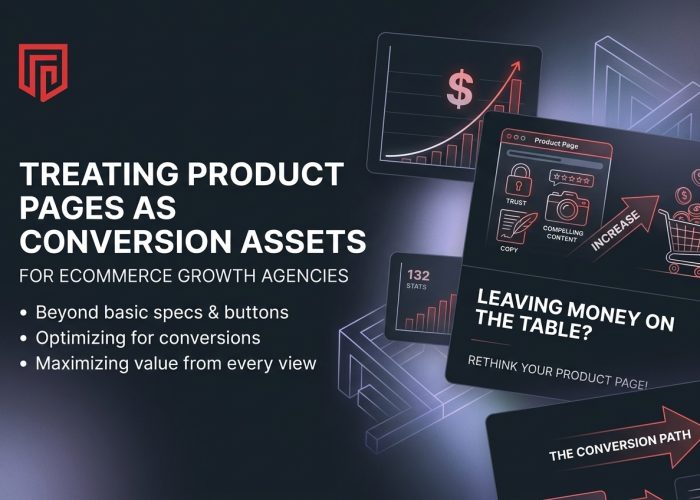
For many online retailers, the product page is still treated like a digital shelf label: a place to list specifications, upload a few images, and add an “Add to Cart” button. That mindset leaves money on the table.
Ecommerce growth agencies tend to see product pages very differently. To them, these pages are not static pieces of catalogue content. They are conversion assets: high-intent environments where brand perception, merchandising, persuasion, and user experience all come together in one decisive moment.
That distinction matters. Traffic can be expensive. Whether it comes from paid search, social ads, email, SEO, or affiliates, every visitor arriving on a product page represents an investment. If the page doesn’t help the customer move confidently toward purchase, the business ends up paying to generate indecision.
Product Pages Sit Closest to Revenue
Homepages build trust. Category pages support discovery. Blog content attracts awareness. But product pages are where purchase intent becomes measurable action.
When a shopper lands on a product page, they are usually past the curiosity stage. They want answers. Is this the right product? Is it worth the price? Can I trust the quality? How quickly will it arrive? What if it doesn’t fit or work as expected?
Growth-focused teams know that each unanswered question creates friction. And friction, even in small doses, has a direct impact on conversion rate, average order value, and return on ad spend.
That is why experienced operators obsess over details that less mature brands often overlook: image sequencing, mobile layouts, variant selection logic, review placement, delivery messaging, stock visibility, return information, and the clarity of the call to action. None of these elements exists in isolation. Together, they shape buying confidence.
A Product Page Is a Sales Conversation in Digital Form
Think of an effective product page as the online equivalent of a strong in-store sales assistant. It anticipates hesitation before the customer voices it. It highlights what matters most. It removes ambiguity. It reassures without overwhelming.
That’s also why agencies specialising in conversion and merchandising often invest significant time into product page strategy before making bigger acquisition recommendations. Businesses looking for support from experienced eCommerce scaling consultants are often surprised to find that growth conversations start here, not with ad budget discussions. The logic is simple: driving more traffic into a weak product page rarely creates efficient growth. It just amplifies leakage.
The strongest ecommerce teams understand that conversion rate optimisation is not only about button colours or headline tests. It is about helping users make decisions with less effort and more certainty.
What High-Performing Product Pages Actually Do
They Reduce Cognitive Load
Customers should not have to work hard to understand what is being sold, why it matters, and what to do next. Yet many product pages bury value beneath cluttered layouts, generic copy, or overdesigned interfaces.
The best pages create clarity fast. They make the product name, key benefit, price, availability, and purchase path immediately visible. They also organise supporting information in a way that feels intuitive rather than dense.
A strong page often answers four questions above the fold:
- What is it?
- Why is it valuable?
- How much does it cost?
- What should I do next?
That sounds obvious, but plenty of brands still fail this test, especially on mobile.
They Sell Outcomes, Not Just Features
Features matter, but outcomes convert. A shopper buying a waterproof jacket is not really buying “sealed seams” and “20,000mm protection.” They are buying confidence in bad weather. A customer browsing ergonomic office chairs may care less about foam density than about avoiding back pain after six hours at a desk.
Growth agencies often rewrite product page copy to bridge that gap. Not by abandoning detail, but by framing detail through customer value. Technical specifications should support the sale, not carry it on their own.
They Handle Objections Before They Become Drop-Offs
Most abandoned product page visits are not random. They usually trace back to unresolved objections.
Common examples include:
- uncertainty about size, fit, or compatibility
- doubt about quality or legitimacy
- confusion around shipping costs or delivery times
- anxiety about returns
- concern that the product may not match expectations
High-converting product pages address these concerns proactively through reviews, FAQs, comparison tables, trust signals, sizing guidance, user-generated content, and transparent policies. This is especially important for higher-consideration purchases, where the customer needs reassurance as much as information.
Why Agencies Prioritise Testing on Product Pages
A product page has more measurable levers than almost any other page type in ecommerce. Change the image order and engagement shifts. Reframe the headline and clarity improves. Move delivery messaging closer to the CTA and hesitation drops. Add social proof at the right moment and conversion rate increases.
This makes product pages ideal environments for structured experimentation.
Small Improvements Compound Quickly
An increase from 2.1% to 2.5% conversion rate may not sound dramatic. But across thousands of product page sessions, that lift can translate into substantial revenue without increasing traffic spend. Pair that with a higher average order value from better cross-sell placement or bundle logic, and the impact becomes even more meaningful.
This is one reason growth agencies treat product page optimisation as a commercial priority, not a design tidy-up exercise.
They Expose Broader Operational Issues
Product page performance also reveals problems elsewhere in the business. If reviews mention confusing sizing, the issue may be product data quality. If customers abandon because delivery dates feel vague, fulfilment communication may need work. If visitors linger but do not buy, pricing or positioning may be misaligned.
In other words, product pages are diagnostic tools as much as conversion tools. They surface the real barriers between demand and revenue.
The Strongest Brands Build Product Pages Around Buyer Intent
Not all shoppers arrive in the same mindset. Some are ready to buy. Some are comparing alternatives. Some need education. Great product pages recognise these different intent states and serve each one without becoming bloated.
That might mean leading with benefits for colder audiences, adding comparison content for evaluation-stage buyers, or using prominent reassurance messaging for customers discovering the brand for the first time.
The point is not to cram everything onto the page. It is to structure information in the order people need it.
Final Thought: Traffic Matters, but Page Quality Decides Efficiency
There is a reason seasoned ecommerce growth agencies return to product pages again and again. These pages sit at the intersection of intent, persuasion, and transaction. When they are built well, they don’t just support conversions; they multiply the value of every acquisition channel feeding into them.
And when they are weak, no amount of traffic can fully compensate.
That is why smart ecommerce operators stop treating product pages as basic catalogue entries. They treat them as some of the hardest-working assets in the business, because that is exactly what they are.