
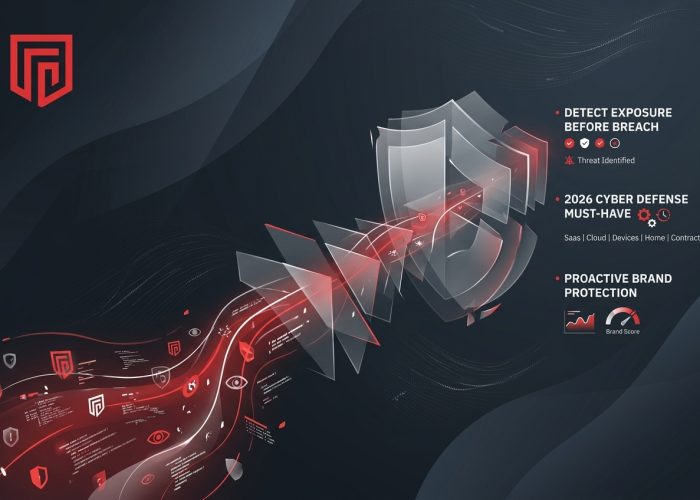
In 2026, owning a business means owning a digital attack surface.
Your employees use SaaS tools. Your customers create accounts. Your teams log in from laptops, phones, home networks, contractors’ devices, and cloud applications. Somewhere in that ecosystem, credentials can be stolen, leaked, traded, or sold long before your internal security tools see anything suspicious.
That is why professional data breach monitoring is no longer optional. It is now one of the most practical ways to detect exposure before it becomes a breach.
The threat has changed
For years, many businesses thought about data breaches as large, public events: a database gets hacked, emails and passwords are leaked, and users are told to reset their passwords.
That view is outdated.
Today, one of the most serious threats comes from infostealer malware. Infostealers quietly infect devices and extract browser-stored passwords, session cookies, SaaS logins, device details, and other sensitive access data. In many cases, attackers do not need to “hack” into a company at all. They simply buy valid credentials or session tokens and log in.
This matters because stolen session cookies can bypass MFA. A business may believe it is protected because employees use multi-factor authentication, but if an attacker has a valid session token, they may be able to skip the login process altogether.
Palo Alto Networks’ 2026 Unit 42 Incident Response Report found that identity weaknesses played a role in nearly 90% of investigations, and 65% of initial access was driven by identity-based techniques such as social engineering, credential misuse, and session hijacking.
The cost of reacting too late is too high
The financial impact of a breach is not theoretical. IBM’s 2025 Cost of a Data Breach Report puts the global average cost of a data breach at $4.4 million.
For smaller companies, the damage can be even more existential. A breach can mean operational downtime, legal exposure, customer churn, reputational damage, lost deals, regulatory pressure, and months of executive distraction.
The problem is that many companies still rely on “checkbox” monitoring. They check occasionally. They rely on generic breach databases. They get alerts without context. They find out a password was exposed, but not whether it came from an infostealer, whether cookies were stolen, which device was infected, which SaaS apps may be exposed, or whether the account is actually high risk.
In 2026, that is not enough.
Attackers operate in hours, not months. Unit 42 reported that the fastest attacks moved from initial access to data exfiltration in just 72 minutes. If your business checks for exposed credentials once a month, the attacker has already won the race.
What professional breach monitoring should provide
A mature breach monitoring program is not just a list of leaked passwords. It should give your business three things:
- Continuous visibility
You need to know when credentials, cookies, sessions, or sensitive assets linked to your company appear in breaches, infostealer logs, combo lists, underground forums, marketplaces, and relevant channels. - Context that makes the data actionable
Not every exposure has the same level of risk. Professional monitoring should help you understand the source, timestamp, malware family, affected identity, related domains, device indicators, and whether the exposure involves credentials, cookies, or session tokens. - Automation and integration
Detection is only useful if your team can respond quickly. The right platform should connect to your existing security workflows, including SIEM, SOAR, IAM, IdP, and ticketing systems, so teams can reset passwords, revoke sessions, enforce MFA, lock accounts, or escalate incidents quickly.
This is the difference between simply knowing a breach happened and actually preventing that exposure from becoming a business incident.
Why every business needs this, not just enterprises
Professional breach monitoring used to feel like an enterprise-only capability. Large companies had security teams, threat intelligence budgets, and access to dark web data. Smaller companies were often left with basic tools, delayed alerts, or no monitoring at all.
But attackers do not only target enterprises. They target any business with valuable access: customer accounts, admin panels, payment systems, employee inboxes, CRM tools, cloud environments, developer platforms, and third-party portals.
A small business may have fewer employees, but that can make every compromised account more damaging. One stolen admin login can expose customer data. One compromised finance account can lead to fraud. One stolen developer credential can create a supply chain risk.
In 2026, the question is not whether your business is “big enough” to need breach monitoring. The question is whether your business can afford not to know when its credentials are already exposed.
Lunar: the perfect solution for modern breach monitoring
Lunar was built around a simple belief: if data connected to your organization has been compromised, you should know.
Lunar is a free, enterprise-grade compromised-credentials monitoring platform available to every company, everywhere. It gives organizations visibility into exposure connected to their verified domains, including infostealer logs, database breaches, combo lists, leaked cookies, and sessions, all unified into a clear events feed.
What makes Lunar different is that it is designed for the way modern identity attacks actually happen.
Lunar helps businesses detect compromised credentials and session cookies across exposure points, prioritize risk with richer context, and act faster through integrations and automation. Its monitoring covers sources such as infostealer logs, breach dumps, dark web marketplaces, and hidden forums, giving teams early visibility into identity risks tied to their organization.
For companies that need to operationalize breach response, Lunar supports workflows such as password resets, session invalidation, MFA enforcement, account lockouts, alerting, data exports, API access, and integrations with security and identity systems.
That means Lunar is not just another breach lookup tool. It helps businesses move from reactive firefighting to proactive identity exposure management.
Free visibility, advanced capabilities when you need them
One of Lunar’s strongest advantages is its model.
Every organization can verify its domain and see exposure connected to that domain. Access to breach visibility is free. For teams that need more advanced capabilities, Lunar offers enterprise-grade features such as advanced analytics, automation, alerting, integrations, and operational workflows.
This makes Lunar especially powerful for business owners in 2026. You do not need to wait for a budget cycle, a long procurement process, or a major incident to understand your exposure. You can start with visibility, then scale into automation and response as your needs grow.
The bottom line
In 2026, data breach monitoring is not just an IT task. It is a business resilience requirement.
Stolen credentials, infostealer logs, leaked cookies, and session hijacking have turned identity into one of the fastest paths into an organization. Traditional security tools still matter, but they cannot protect what they cannot see. If your employees, customers, or business assets are already exposed outside your perimeter, you need to know before attackers use that access.
Professional breach monitoring gives business owners the visibility, context, and response capability needed to reduce risk before it becomes a crisis.
Lunar makes that possible for every company.
Create your free Lunar account, verify your domain, and see what exposure already exists across breaches, infostealer logs, leaked cookies, and compromised credentials. In 2026, the businesses that stay ahead will be the ones that detect early, prioritize fast, and act before attackers get the chance.