Startups are spoiled for choice when it comes to selecting AI tools. The fact that disruptive code-writing copilots, smarter customer service agents, and a myriad of other tools seem to upend the existing market each month isn’t helping, either.
Not wanting to fall behind, some startup founders are tempted to embrace such tools without thinking through the long-term consequences. They forget that effectiveness — not the size of the tool stack — is the true measure of adoption success.
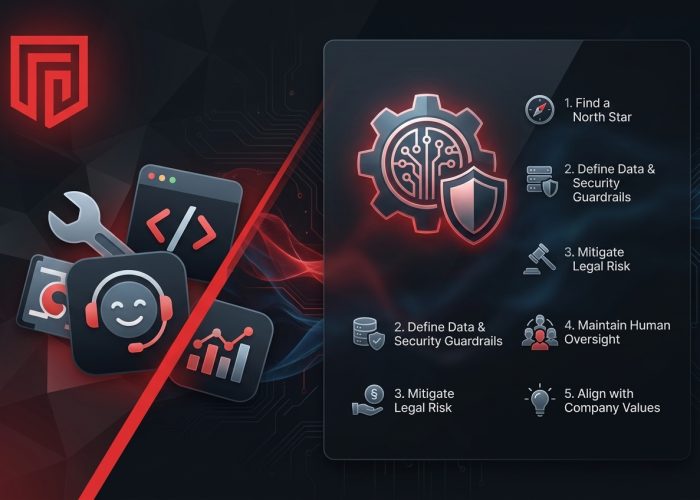
Establishing AI guardrails first plays a pivotal role in this. Here are five compelling reasons why this is so, and a simple checklist you can follow to efficiently implement guardrails from the start.
It discourages shadow AI
A startup is the kind of environment in which employees are likely to start experimenting with shadow AI even if leadership isn’t dragging its feet regarding policy implementation. Overreliance on unvetted tools creates disjointed workflows and knowledge gaps since only select employees might know how a tool works.
It prevents leaks and protects trust
Worse yet, employees might expose proprietary data by feeding it to publicly available models. A piece of technology advice would be to implement simple guardrails, as they can prevent said leaks by defining what data can be shared with which AI tools and when a human review is called for. Resilience to leaks also translates to better customer and investor trust since it noticeably reduces security, privacy, and compliance risks without hampering employees’ AI usage.
It helps create consistent, high-quality outputs
Process standardization is more effective than tool sprawl at ensuring reliable outcomes. After all, the more tools you introduce without guidance, the greater the chance that individual team members will all use them differently.
Governance needs to come first to establish standards. It determines when using AI is appropriate and when human oversight leads to better results. Governance is also invaluable for determining accountability for AI outputs and establishing protocols for verifying AI-generated results.
It makes early investor and market wins easier
Startup founders tend to defer thinking about concepts like AI governance in the early stages until their company has achieved demonstrable growth. Ironically, having a lightweight governance framework in place from the outset may make the startup look more credible.
Enterprise investors are aware of AI’s increasing involvement in startup development. Demonstrating that you can competently handle data, vendor relationships, and related AI risks signals operational maturity and leadership with foresight.
It boosts future growth while reducing needless AI spend
Haphazard AI tool adoption inevitably leads to unnecessary redundancies and overlapping workflows. Governance puts measures in place that help evaluate new tools and retire old ones. Done right, governance gives teams the clarity to move faster and experiment with confidence.
If anything, outlining a deliberate tool adoption strategy as part of your governance policies ensures more forethought goes into their selection. If criteria like scalability and workflow integration are examined thoroughly for each new tool, you avoid fragmentation while also reducing expenses.
How to set guardrails up early
Following the steps below will help you establish robust guardrails early on.
- Write an AI usage policy – This can be as simple as a few pages outlining approved AI tools, what data employees are allowed to share, which tasks need reviewing, and who is responsible for AI outputs. This creates a baseline for everyone to work off of.
- Choose AI gateways that will reinforce guardrails – Choose AI gateways that will reinforce guardrails – The best AI tools are those that integrate smoothly with your existing processes without creating security loopholes. Popular tool comparisons like nexos.ai vs TrueFoundry come in handy to check out, as both position themselves as control layers for managing AI access.
- Intentionally keep a small AI stack – This avoids the trap of AI tool oversubscription. Choosing a handful of AI platforms well will cover most use cases. Fewer tools are also easier to secure and train new hires on.
- Regularly review and refine the policy – Approved tools, usage guidelines, and workflows change rapidly. Updating your framework every few months helps you stay current and avoid mounting practice inconsistency as your team grows.
- Make responsible use part of training – People will have a much easier time accepting and following guardrails if they understand why these exist. Often, a brief onboarding session is all it takes for employees to start using AI appropriately while avoiding costly mistakes.