
The rise of cryptocurrency has created an entirely new way for individuals to build wealth outside of traditional financial systems. Many investors have seen their holdings grow substantially, providing them opportunities to diversify their assets. However, while crypto wealth can be volatile, real estate remains a stable and appreciating investment. One way to bridge the gap between digital assets and homeownership is through mortgage refinancing.
By leveraging refinancing options, investors can secure better loan terms and potentially use their crypto gains to build long-term financial security. For those exploring their financing options, understanding the difference between a second mortgage vs home equity loan is crucial when considering how best to convert digital assets into real-world property investments.
How Crypto Wealth Can Improve Refinancing Options
Through cryptocurrency, investors gained financial freedom because they previously needed only traditional income to secure loans. The evolution of the crypto industry has encouraged financial institutions to welcome borrowers who possess digital wealth assets even though they continue to avoid accepting crypto directly as an asset. Homeowners who possess mortgages can utilize refinancing as an effective strategy to optimize their loan conditions through their crypto earnings or extract equity to develop new investments.
Refinancing enables homeowners to obtain decreased interest rates as one of its main advantages. Since then, the combination of obtaining your mortgage at elevated rates and enhanced credit has created an opportunity for refinancing, resulting in reduced monthly payments and significant long-term savings. Homeowners with crypto gains can use the extra liquidity through mortgage payments to pay down their mortgages substantially or enhance their financial profile, thereby improving their lender appeal.
People with non-traditional income from self-employment may use their crypto assets as collateral to improve their mortgage application strength. Debt-to-income ratios become more favorable when cryptocurrency holders convert their gains into traditional currency and grow their cash reserves, which helps lenders approve refinancing applications. Real estate is a resilient long-term investment, making crypto an effective tool for refinancing processes.
Using Crypto to Cash-Out Refinance for Homeownership
Homeowners can achieve property acquisitions through mortgage refinancing to extract equity from their homes beyond securing favorable financing terms. A cash-out refinance enables homeowners to exchange their current mortgage for a larger one, which results in receiving the difference as liquid funds. The method proves advantageous to cryptocurrency investors who wish to add variety to their holdings without parting with their existing assets.
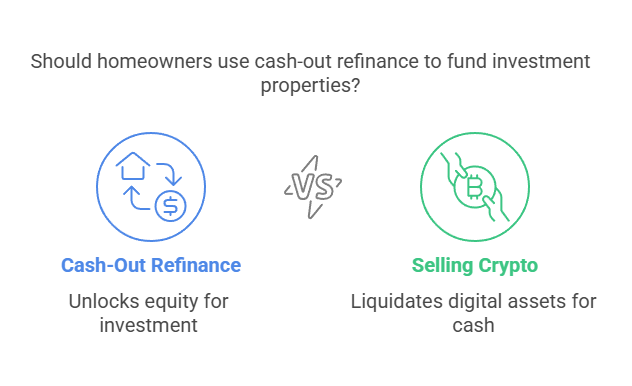
Cash-out refinance is a popular method of obtaining funds to purchase investment properties through down payment funds. Homeowners who wish to buy real estate without selling their crypto need to extract residential property equity through which they obtain funds to purchase investment properties while avoiding tax consequences. Cash-out proceeds can be directed into income-generating rentals Explore rental property options with DSCR loans, which detail qualifying based on rental income, typical down payments, credit score and reserve requirements, and strategies for long- and short-term rentals. The strategy lets investors keep their digital assets untouched while their property value grows.
Overcoming Challenges in Crypto-Backed Refinancing
Using crypto assets to refinance home loans faces various obstacles despite its possible benefits. Traditional lending institutions avoid recognizing digital assets as reliable wealth because these assets show unstable market prices. To qualify for refinancing, investors must demonstrate steady income while converting some digital assets into traditional currency.
Another challenge is documentation. Most banks need documented evidence of asset origins and acquisition records to secure a mortgage refinancing. The decentralized nature of cryptocurrency transactions and their pseudonymous structure make it difficult to prove ownership and legitimacy. The application process for mortgage refinancing demands complete documentation about trades and transfers and thorough records of conversion history.
Conclusion
Real estate becomes a long-term stable asset through mortgage refinancing, providing crypto investors with a transition path from digital assets. Refinancing proves valuable by letting homeowners achieve better interest rates and access home equity for different purposes or enhance their financial position.
Careful planning is essential to managing the application process for mortgage refinancing, specifically when dealing with crypto assets. A smooth transition from crypto gains to homeownership depends on knowing lender specifications, tax management, and professional use of refinancing alternatives. A strategic financial strategy allows investors to use digital assets alongside real estate investments to build a long-lasting financial foundation.