
Cryptocurrency Lets Digital Value Move Between Players and Across Connected Game Worlds
Blockchain gaming uses distributed-ledger technology inside a digital game. The technology can track selected assets, record transactions, support currencies, or run defined game rules.
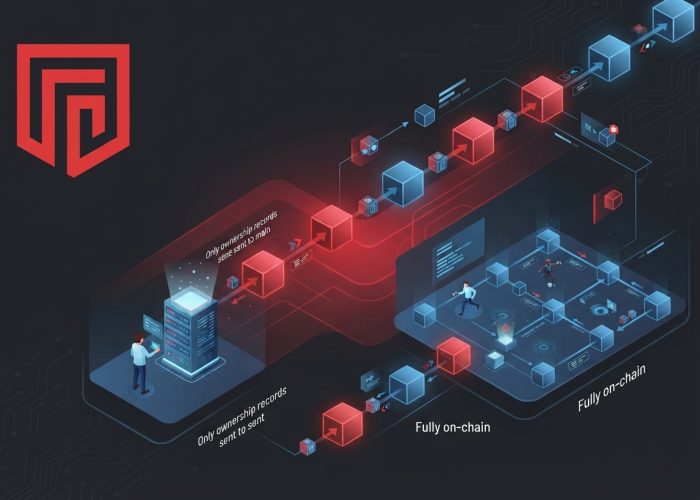
That does not mean every blockchain game is fully on-chain. Many blockchain games use ordinary servers for the fast parts of play while placing only ownership records or transfers on a blockchain. Fully on-chain gaming is the narrower category where core logic and game state sit on the network.
Key Takeaways
- Blockchain games share ledgers to track game data, transactions, items, or rules.
- Fully on-chain games place core game logic into smart contracts.
- Crypto wallets work as player IDs plus tools to hold/move blockchain game items.
- Tokens can be in-game money, rewards, or exclusive digital items.
- Cryptocurrencies in gaming let transferable digital value fit in blockchain game worlds.
What Makes a Game a Blockchain Game?
Traditional games generally keep player accounts, inventories, and game data on servers controlled by the publisher. The publisher’s database records who owns an item and what has happened in the game.
Blockchain gaming moves some of those records onto a distributed ledger. A game might represent a character skin, card, or currency balance as a token. The transfer of that asset can then be recorded by the underlying blockchain rather than only in the publisher’s database.
| Feature | Traditional game | Blockchain game |
| Player Data | Centralized servers | Servers, blockchain or both |
| Digital Assets | Internal game records | May be represented by blockchain tokens |
| Transactions | Internal database entries | Some transfers recorded on-chain |
| Player Access | Standard account | May include a crypto wallet |
| Game Logic | Developer-controlled servers | Server-based, partly on-chain or fully on-chain |
This can introduce cryptocurrencies in gaming as a medium for transfers, rewards, or game economies. It does not mean every blockchain game requires a player to buy cryptocurrency, or that every token has a practical use outside its own system.
How Do On-Chain Games Actually Work?
In a fully on-chain game, a smart contract can hold core rules and record changes to the game state. A player action becomes a blockchain transaction rather than a simple request to a central server.
A basic sequence can look like this:
- The player connects a wallet.
- The player initiates an in-game action.
- A smart contract processes the action under its preset rules.
- The network records the resulting state change.
- The game interface displays the updated result.
The interface may still look like any other game. The difference is where the authoritative record lives and how the rules are executed.
On-chain gaming brings trade-offs. A blockchain transaction takes time to be confirmed and can carry a network fee. That is manageable for some actions, such as transferring an item, but cumbersome for constant movement or rapid combat.
The Building Blocks of Blockchain Gaming
Smart Contracts
Smart contracts are programs deployed on a blockchain. They execute a stated function when a transaction calls them and the required conditions are met.
In a game, a smart contract can define how an asset is minted, how an item transfers or how a particular rule changes the game state. It follows the code that was deployed, which makes careful development and auditing important.
Crypto Wallets
A crypto wallet holds credentials that allow a player to sign blockchain transactions. It may act as the identifier a game recognizes, although it is not the same as a conventional username and password system.
The player also carries security responsibility. Losing control of wallet credentials can mean losing access to blockchain game assets. A wallet connection should therefore be treated as a financial and security action, not a decorative login button.
Tokens and Digital Assets
Fungible tokens are interchangeable units. They can be used as currency or utility assets within a game’s economy. Non-fungible tokens, or NFTs, can represent distinct items such as a named character, card or piece of equipment.
These assets are not automatically usable elsewhere. Blockchain token standards can make a token recognizable on a network, but another game still has to support the asset and decide what it means within that game.
Why Isn’t Every Part of a Blockchain Game On-Chain?
Writing every action to a blockchain creates friction. Networks have throughput limits. Transactions can cost money. Storage is limited and confirmation delays can feel slow in a real-time game.
That is why hybrid design is common in Web3 gaming. A conventional server may handle matchmaking, movement, combat updates and visual effects. The blockchain may handle ownership records, item transfers or settlement events.
This does not make a hybrid game less legitimate. It simply describes its architecture. Blockchain gaming is a broad category. Fully on-chain gaming is one approach within it.
What Blockchain Changes for Players
Blockchain game assets can have a visible transaction history. A player may be able to transfer an eligible token through a wallet without relying on a game’s internal marketplace.
Smart-contract rules can also be inspectable by technically skilled users. Yet transparency is not the same as simplicity. Players may face wallet setup, transaction fees, network selection and the risk of irreversible mistakes.
A blockchain record can establish that a token exists at a given address. It cannot guarantee that a game will remain online, that an item will retain utility, or that another application will recognize it.
Covering a Spectrum
Crypto gaming covers a spectrum of designs. One game may use a token only for selected asset transfers. Another may place its core rules, state and economy on-chain.
The useful question is not whether a title uses blockchain at all. It is which parts of the game use it, why they use it, and what that changes for the player.
Frequently Asked Questions
Do you need cryptocurrency to play every blockchain game?
No. Requirements vary. Some games allow ordinary play without a purchase, while others require a wallet or tokens for certain functions.
Can blockchain game assets be transferred between different games?
Only if the other game supports the asset and assigns it a use. Ownership on a blockchain does not create automatic interoperability.
What happens to blockchain assets if a game shuts down?
The token may remain on the blockchain, but the game, interface, and utility associated with it may no longer be available.
Do players pay a blockchain transaction fee for every game action?
It depends on the architecture. Hybrid games often keep routine actions off-chain, while fully on-chain actions can require transactions and network fees.