
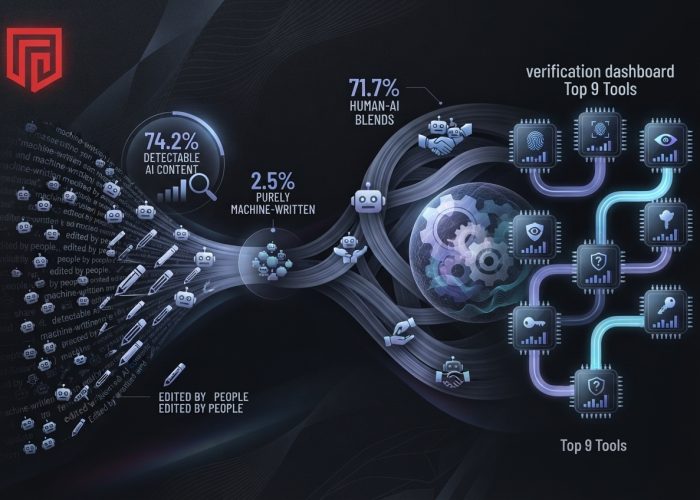
When Ahrefs analyzed roughly 900,000 web pages published in a single month, 74.2% contained detectable AI-generated content. The number that matters for verification teams is the breakdown underneath it: only 2.5% were purely machine-written. The remaining 71.7% were human-AI blends – drafted by a model, edited by a person, and statistically far harder to classify than either extreme.
That gap is the whole problem. Detection tooling performs reasonably well on raw model output and degrades sharply on blended text, which is now the dominant publishing pattern. Meanwhile, the trust surface keeps expanding: Verizon’s 2026 Data Breach Investigations Report found threat actors drawing on generative AI across a median of 15 distinct MITRE ATT&CK techniques – scaling established methods rather than inventing new ones – and organizations are absorbing machine-drafted text into technical documentation, vendor questionnaires, and incident write-ups faster than they are building any process to verify it.
Two categories of tools have grown up around this. AI detectors classify text by origin. AI humanizers restructure machine-drafted text so it reads the way a person writes. Teams need both, for different reasons – one to verify what arrives, one to raise the quality of what leaves.
The mechanism is measurable, which is what makes this technical rather than stylistic. Raw LLM output carries statistical fingerprints: average sentence length near 29 words against a human average closer to 23; mean word length around 5.86 characters against roughly 5.24; low punctuation variety; abstract grammatical subjects (“It is important to note that…”) in place of direct address; uniform sentence rhythm; high vocabulary reuse between adjacent sentences. Detectors read these distributions. Structural rewriters shift them.
Nine tools across that stack, assessed on mechanism, evidence, and workflow fit. Limitations are included for all nine, because in this category they are the more useful half of the evaluation.
- HumanizeAI – best for register-preserving restructuring with signal-level detection feedback
Overview. Humanize AI is a specialized text refinement platform rather than a generator: it takes AI-assisted drafts and restructures them for flow, readability, and structural variety. Its distinguishing design decision is working inside the formal and academic register instead of escaping it – targeting the statistical signals detectors classify on without converting technical prose into conversational prose to get there.
How it works. The engine operates at the grammatical level, not the lexical one – new grammatical subject per sentence, different verb constructions, subordinate clauses repositioned, sentences merged or split where meaning allows. The result is a different token distribution rather than the original sentence with synonyms layered over it. Explicitly excluded: word substitution, casual register shifts, sentence bloating, and any content generation. Eight modes are selectable (Standard, Academic, Simple, Flowing, Informal, Formal, Expand, Shorten), plus an opt-in Ultra run toggle for heavily fingerprinted text; Ultra requires registration and is off by default.
Why the register constraint is the interesting part. Detectors train on two distributions, and the human side skews heavily toward academic writing, Wikipedia, and formal essays – which sits very close to default LLM output. Most humanizers reduce scores by pushing text toward casual register: contractions, filler, simpler vocabulary. That works mechanically and destroys the document for anyone writing a threat report or a compliance narrative. Finding structural rewrites inside the formal zone is the harder engineering problem, and it is the one this tool is built around.
Relevance for technical teams. The View changes toggle highlights every edit in the output, giving auditable visibility into what was restructured – useful for confirming no technical term or compliance phrasing was altered. Selective rephrase isolates changes to a highlighted passage and leaves clean text untouched (3 free attempts on unpaid accounts, unlimited from Standard up). File-to-File accepts PDF, DOCX, TXT, or MD and returns the same format, capped at 10MB free and 25MB paid – relevant for long documents that would otherwise be chunk-pasted. Custom Style trains a saved profile on up to three of the user’s own writing samples (150–1,200 words total).
The detector. The standalone detector page is free, unlimited, and requires no account, cross-checking eight systems – Turnitin, Copyleaks, Originality.ai, GPTZero, Crossplag, Sapling.ai, Gowinston.ai, ZeroGPT – with per-detector pass/fail. The differentiating layer is the reasoning panel: for each flagged segment it names the measurable signal that drove the classification and quotes the sentence it refers to (“average sentence length 23.2 words against an AI average of 29.2”). A per-model breakdown attributes likely authorship across ChatGPT, Claude, Gemini, Grok, and DeepSeek. Both are ungated.
Why it matters. The reasoning panel turns the tool diagnostic. Teams learn which patterns are present in their drafts and can adjust upstream prompting to reduce downstream remediation, rather than looping blindly through a rewrite-and-recheck cycle.
Limitation. The detector is manual – it does not fire automatically after a humanization run. The inline post-humanization view shows a summary score with per-detector pass/fail; the full reasoning breakdown requires moving to the standalone detector page (a “See full report” control transfers the text without re-pasting). Anonymous humanization is capped at 200 words per cycle, and 400 requires a free account.
Pricing. Free: 200 words/cycle anonymous, 400 registered, unlimited runs. Lite $9.99/mo (10,000 humanizer words, 500 per process). Standard $19.99/mo (25,000 words, unlimited per process, re-humanize, unlimited selective rephrase). Unlimited $59.99/mo.
- GPTinf.com – best all-in-one content integrity suite
Overview. GPTinf is a full writing toolkit rather than a single-purpose humanizer: humanizer, detector, plagiarism checker, grammar checker, paraphraser, and readability checker on one platform. For teams currently moving text between three or four services, the consolidation argument is also a data-handling argument.
How it works. The humanizer runs on a proprietary non-LLM structural rewriting engine – the same grammatical-level reconstruction, producing a different token distribution rather than a re-generation. Two modes are currently exposed in the interface, Standard and Academic. On internal benchmarking against GPTZero, output averaged 0.0017 AI probability where tested competitors on the same text ranged from 0.56 to 1.00.
Relevance for technical teams. The grammar checker runs on a self-hosted LanguageTool engine, so text submitted to it does not transit third-party servers – a concrete answer to the question a security reviewer asks first. File upload (PDF, Word, plain text) is available on every tier including free. The broader consolidation point is straightforward: each additional third-party tool in a content chain is another surface where draft material leaves your control, and collapsing five into one removes four of them.
Detection integration. The detector fires automatically after every humanization run – the score appears beneath the output with no button click – cross-checking eight systems (Turnitin, Originality.ai, Crossplag, Gowinston.ai, Copyleaks, GPTZero, Sapling.ai, ZeroGPT). It is also usable standalone, free and unlimited without an account, carrying the same reasoning panel and five-model attribution breakdown, ungated. The detector interface is available in nine languages.
Plagiarism checking. The platform’s most data-backed component. In head-to-head testing across seven checkers on identical text, GPTinf returned 152 matched sources with sentence-level attribution. Next closest was Copyleaks at 14, then Quetext at 7; Grammarly surfaced nothing on its free output. Anonymous users see the top three sources, with the rest behind a signup prompt.
Why it matters. For a team processing AI-drafted material at volume, the automatic detector pass is the operationally significant feature – verification becomes a default step rather than a discipline someone has to remember.
Limitation. No public API and no browser extension; it is a strong interactive platform, not an integrable one. Free-tier humanization is capped at 300 words per request with daily run limits (5/day anonymous, 10/day registered), and the free plagiarism checker analyses 500 words per check.
Pricing. Free $0. Lite $9.99/mo (5,000 words). Pro $24.99/mo (25,000 words, re-humanize, unlimited selective rephrase). Unlimited $59.99/mo.
- UndetectableAI.pro – best narrow-scope tool for reducing detector flags on published copy
Overview. Where the previous two tools are platforms, Undetectable AI is a single-purpose structural rewriter. It targets the specific statistical fingerprints that classification models score on – perplexity variance, burstiness, sentence uniformity, token predictability – and does not attempt suite breadth.
How it works. Transformation is applied against the signal models used by the major detection systems rather than against a general notion of “natural writing.” The practical difference from a broad rewriter is focus: fewer knobs, narrower objective.
Relevance for technical teams. The honest use case is false-positive management on published material. Detector false positives carry real operational cost – a technical blog post, documentation set, or vendor response that a client-side detector flags creates a credibility problem regardless of how it was actually written, and non-native English writing is flagged at measurably higher rates than native-English human text.
A caution worth stating plainly. Tools in this category should not be used to route AI-drafted material past verification controls an institution is relying on to make a decision – academic submission systems, regulatory filings, or attestations where authorship is part of what is being certified. That is not a capability question; it is a question of whether the gate exists for a reason. Vendors in this space, including the two above, are explicit in their own guidance that these tools are positioned around authentic voice and false-positive reduction rather than defeating integrity checks.
Limitation. Narrow by design. No plagiarism checking, grammar QA, or integrated detection, so it functions as a companion to a platform rather than a replacement for one.
Pricing. Free: 1,000 words without registration, plus a further 1,000 on creating a free account. Lite $9.99/mo (5,000 words). Pro $25/mo (25,000 words, re-humanize, unlimited selective rephrase). Unlimited $59/mo — metered at 1,000,000 words.
- Originality.ai – best for editorial verification
Overview. A detection platform built for publishers, agencies, and editorial teams that need reliable classification at volume – the verification end of the stack.
How it works. Full-page scanning with team management, API access, readability scoring, and three-way classification: AI-generated, human-and-AI-refined, or fully human. That middle category matters, given that blended text is the dominant real-world case.
Relevance for technical teams. API access is the differentiator. Detection embeds directly into a CMS, editorial review queue, or documentation pipeline as a programmatic gate rather than a manual step someone performs inconsistently.
Why it matters. Multiple humanizer vendors name Originality.ai as the benchmark they measure against, a reasonable proxy for its standing as one of the stricter systems in the category. Knowing which detector your content will face is as operationally relevant as knowing which CVEs a scanner covers.
Limitation. Detection only – no humanizer, grammar tooling, or plagiarism checking. Credit-based pricing makes cost forecasting harder for teams with variable throughput.
Pricing. Credit-based, with subscription and one-time options. Current rates at originality.ai.
- GPTZero – best detection baseline for institutional environments
Overview. One of the earliest and most widely deployed detectors, purpose-built for education and increasingly used by publishers as a baseline verification layer.
How it works. A proprietary combination of perplexity and burstiness scoring. Perplexity measures how predictable the text is relative to what a language model would produce; burstiness measures variance in sentence length. Human writing tends to score high on both, machine writing low on both. On the RAID benchmark, GPTZero has reported 95.7% detection of AI text at a 1% false-positive rate.
Relevance for technical teams. API access supports pipeline integration, and batch scanning handles multi-file review. The scale of institutional deployment makes it a practical benchmark, since it is likely one of the systems your published material eventually encounters.
Why it matters. Understanding how the most widely deployed institutional detector classifies text gives teams a concrete target for testing, and explains why structural rewriters are engineered against its specific signal model.
Limitation. Documented weakness against well-restructured text – grammatical-level rewriting reduces GPTZero scores substantially, a general property of the category rather than a defect unique to this tool. False-positive rates on non-native English writing run higher than on native-English human text, a known fairness problem worth accounting for in any policy built on detector output.
Pricing. Free tier available. Educator and API plans from roughly $10–15/mo.
- QuillBot – established paraphrasing suite with broad integration coverage
Overview. One of the most widely recognized writing assistant adjacent to this category, with a humanizer bundled alongside a paraphraser, grammar checker, plagiarism checker, summarizer, translator, and citation generator.
How it works. A Chrome extension operates in place across ChatGPT, Gemini, Google Docs, Gmail, and a very large set of other sites, so text is processed without a copy-paste round trip. Custom voice profiles adapt output to a user’s existing style from a sample of roughly 200 words upward.
Relevance for technical teams. Multilingual support (Spanish, German, French, Portuguese, four English dialects) matters for teams producing documentation across regions.
Why it matters. When tool selection has to survive procurement or compliance review, an established vendor with a long adoption record clears that bar more easily than a newer specialist – a consideration that belongs in the evaluation even though it has nothing to do with output quality.
Limitation. The humanizer is an add-on to a paraphrasing suite rather than a purpose-built structural engine, and performance against current detectors is less consistent. Synonym-level paraphrasing in particular remains detectable at high rates.
Pricing. Free (125 words per process, 6 per day). Premium from $4.17/mo annual, $9.95/mo monthly.
- ZeroGPT – best free detector for rapid first-pass screening
Overview. The most-visited free detector in the category, built around frictionless access: no account, sentence-level highlighting on the free tier, immediate results.
How it works. A multi-stage detection model returns an overall AI probability with sentence- and paragraph-level color coding, covering output from GPT-4, Claude, Gemini, LLaMA, and other major models.
Relevance for technical teams. The enterprise tier offers SSO, a user management dashboard, API access, and GDPR-compliant infrastructure hosted in Germany – directly relevant where data sovereignty is a stated requirement.
Why it matters. Zero-friction free access at one end and enterprise API availability at the other makes it usable across the maturity spectrum: an analyst spot-checking one document, or an organization running programmatic screening.
Limitation. Independent testing has reported elevated false-positive rates on genuine human writing, and the tool is a poor gate on restructured text – structural rewriting reduces its scores significantly. It also returns a score and highlights without explaining which signals drove the classification, which limits its value for diagnosis as opposed to screening.
Pricing. Free. Pro from around $7.99/mo annual.
- StealthWriter.ai – best low-friction single-purpose rewriter
Overview. A minimal-interface humanizer built for throughput: paste, select a mode, get output. No suite, no diagnostics.
How it works. Mode options span standard and more aggressive restructuring levels. The interface optimizes for speed over editorial control – a deliberate trade rather than an oversight.
Why it matters. It fits a layered toolchain where a dedicated detector handles verification and only flagged content needs a fast remediation pass. Humanizers are not interchangeable, and the useful question is where each sits in a chain rather than which is “best” in isolation.
Limitation. No integrated detection, plagiarism checking, or grammar tooling, and no explanation of why content was flagged. The absence of change-tracking makes it a poor fit for technically precise material where meaning retention has to be verified rather than assumed. Public pricing was not available at the time of writing.
- Copyleaks – best for language breadth and compliance posture
Overview. An enterprise detection and plagiarism platform with among the broadest language coverage in the category (30+ languages) and a substantial institutional adoption record.
How it works. AI detection alongside source-level plagiarism scanning, with API access for integration into content management systems, LMS platforms, and publishing workflows. Returns per-sentence AI probability with source attribution on flagged segments.
Relevance for technical teams. SOC 2 Type II and GDPR compliance, enterprise SSO, audit logging, and integrations with Canvas, Moodle, and WordPress. Where detector output feeds a decision that has to be defensible, compliance posture carries as much weight as raw accuracy.
Why it matters. The 14-source result against GPTinf’s 152 on identical text illustrates how much source attribution depth varies between platforms. If detector output informs a compliance or editorial decision, that variance is not a footnote – it determines what you actually see.
Limitation. Credit-based pricing scales with volume. Accuracy on restructured AI text is materially lower than on raw model output – a constraint shared by every detector currently available.
Pricing. Credit-based, enterprise plans available. Current rates at copyleaks.com.
Where this category is heading
The AI content authenticity stack is following a familiar maturity curve: early fragmentation, rapid specialization, a widening split between all-in-one platforms and purpose-built point tools. Anyone who watched the security tooling market develop will recognize the shape.
The dynamic driving it is reciprocal. Every gain in detection signal specificity produces a corresponding gain in structural rewriting precision. Teams that understand both halves – what detectors measure, and how restructuring shifts those measurements – make better decisions than teams treating either side as a black box.
A short decision framework:
- Register-preserving restructuring with signal-level feedback – HumanizeAI.pro
- Consolidated toolkit with self-hosted grammar processing – GPTinf
- Narrow-scope rewriting for published copy – UndetectableAI.pro
- Programmatic editorial verification – Originality.ai
- Institutional detection baseline – GPTZero
- Compliance posture and language breadth – Copyleaks
- Rapid first-pass screening – ZeroGPT
- Low-friction remediation step – StealthWriter.ai
- Procurement-friendly established suite – QuillBot
One caveat belongs at the end of any evaluation here: no current detector is reliable enough to be the sole basis for a consequential decision about a specific document. False-positive rates on human writing are non-trivial and fall unevenly on non-native English speakers, and accuracy on blended human-AI text – the 71.7% case – is meaningfully worse than on raw model output. Detectors are useful as a screening signal and poor as a verdict.
That matters more than any ranking. As machine-drafted text becomes routine across technical documentation and external communication, the organizations that come out ahead will be the ones treating verification as a process with known error rates rather than a tool that returns an answer. The tooling is improving quickly. The judgment about what to do with its output still has to be built in-house.