
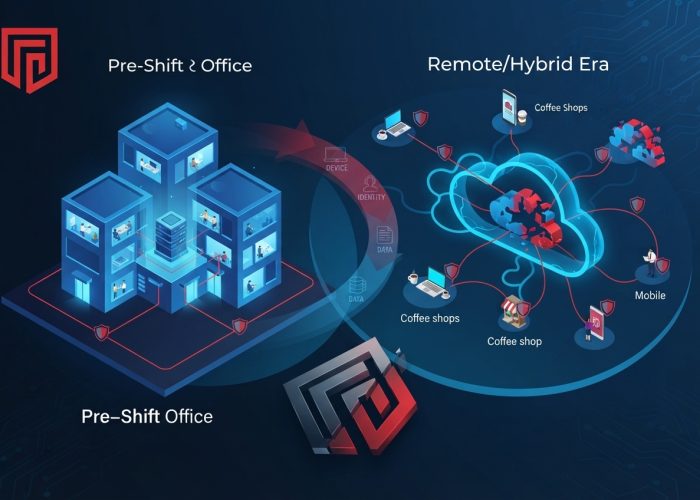
The shift to flexible work has changed how employees connect to corporate networks, cloud applications, and business-critical systems. For many businesses across the United States, the office is no longer the default access point, which means security teams now have to protect users, devices, and data across a far more distributed network environment.
- The rise of flexible working environments
Hybrid and remote work are now firmly embedded in the American workplace. Recent U.S. Bureau of Labor Statistics telework data shows that millions of employed Americans continue to work from home for at least part of the week, making flexible work a long-term operational consideration rather than a temporary arrangement. From an IT perspective, this means users are routinely connecting from home routers, shared co-working spaces, hotel networks, airports, and public Wi-Fi. Each connection point introduces different levels of risk, making the traditional model of securing a single office LAN insufficient on its own. Modern network security now has to account for remote access, endpoint posture, identity verification, and encrypted traffic across multiple environments.
- Understanding the security risks of remote access
Working outside a managed office environment introduces vulnerabilities that are easy to overlook. Public Wi-Fi networks, commonly used in coffee shops, airports, hotels, and shared workspaces, may be poorly secured and can expose traffic to interception. Personal devices may not follow the same patching, firewall, or configuration standards as corporate endpoints, while home networks rarely receive the same monitoring as enterprise infrastructure. U.S. cybersecurity reporting continues to show that phishing, stolen credentials, human error, and endpoint weaknesses remain major causes of business security incidents. These risks underline why remote access security must be treated as a core part of network design rather than an optional add-on.
- Technology that helps secure online connections
A layered approach is needed to secure users who connect from outside the corporate perimeter. Multi-factor authentication, endpoint protection, patch management, DNS filtering, secure access policies, and device management all play an important role. For employees working across multiple locations or relying on public networks, understanding what is a vpn vs proxy can provide an additional layer of protection by encrypting internet traffic and reducing exposure on untrusted networks. In U.S. business environments, VPNs may also sit alongside remote access controls, cloud security tools, and zero trust network access models, helping organizations apply stronger protection without relying solely on a fixed office perimeter.
- Building a stronger security culture
Technology alone does not create a secure organization; the way employees handle access, credentials, and devices matters just as much. Teams need clear guidance on recognizing phishing attempts, using strong authentication, keeping software updated, and avoiding unsecured networks when handling sensitive information. At the same time, IT teams need visibility over endpoints, access logs, and unusual connection behavior. When technical controls and user awareness work together, businesses are better placed to reduce risk across a distributed workforce and maintain a stronger overall security posture.
Remote and hybrid work have permanently changed the network perimeter for U.S. businesses. Rather than protecting one central office environment, organizations now need security strategies that follow users wherever they connect. By combining encrypted connections, identity-based access, endpoint management, and practical user training, businesses can build a remote access model that supports flexibility without weakening network security.