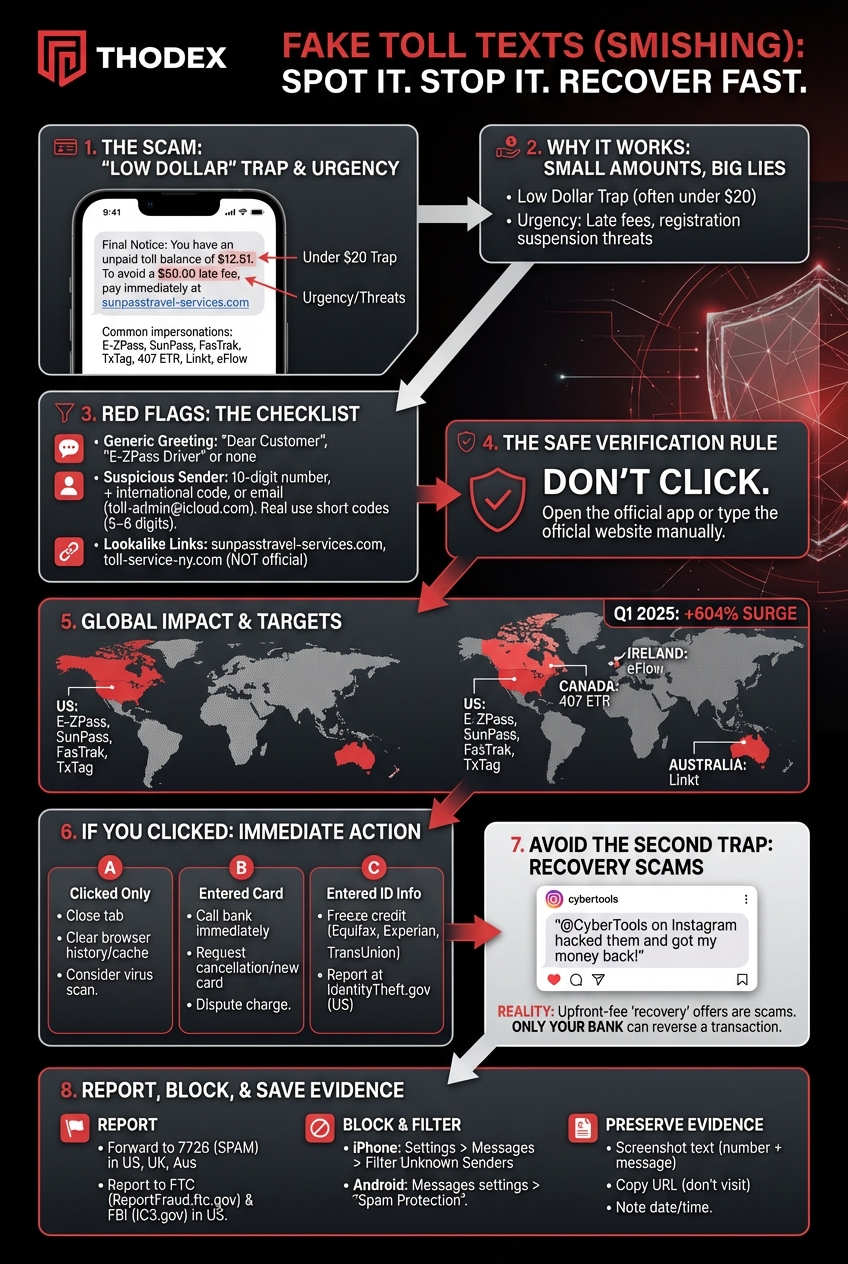
It usually happens when you are least expecting it. You look at your phone and see a text message: “Final Notice: You have an unpaid toll balance of $12.51. To avoid a $50.00 late fee, pay immediately at…”
Your heart drops for a second. You panic. Did you miss a toll booth last week? Did your transponder fail? You don’t want to pay a huge fine, so you reach for the link.
Stop.
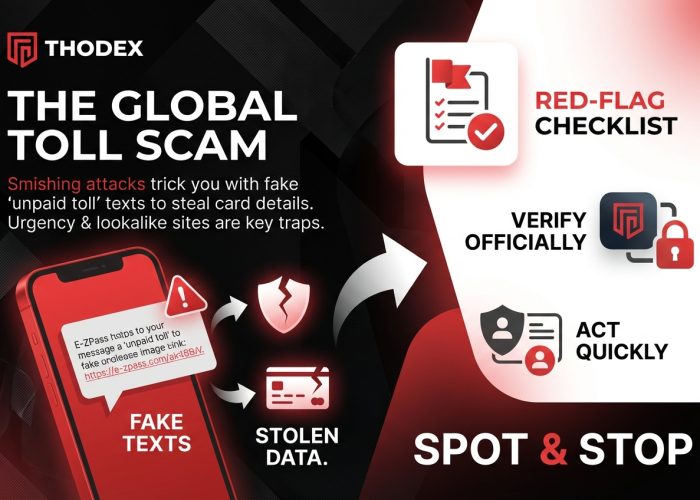
If you click that link, you aren’t paying a toll. You are handing your credit card number directly to criminals. This is known as a toll scam, and it is currently one of the most widespread smishing (SMS phishing) attacks in the world.
Whether the text claims to be from E-ZPass, SunPass, or Linkt, the goal is the same: to steal your money and your identity. Here is everything you need to know to spot the fake text, protect your wallet, and recover if you’ve already clicked.
Anatomy of a Toll Smishing Scam
To defeat this scam, you need to understand how it works. These messages follow a specific script designed to bypass your logical thinking.
The Message
The text usually looks generic. It will say something like:
“We’ve detected an unpaid balance on your account. Settlement is required to prevent vehicle registration suspension.”
Why It Works: The “Low Dollar” Trap
You might expect scammers to ask for thousands of dollars. They don’t. In a toll scam, the request is almost always under $20 (usually around $12.51 or $11.75).
This is a psychological trick. If a scammer asks for $500, you will call the agency to complain. But if they ask for $12, you are more likely to think, “It’s just twelve bucks, I’ll pay it just to make this problem go away.” That small payment is the key that unlocks your bank account for them.
The Link
The text includes a link that looks almost real. Instead of the official site, you might see sunpasstravel-services.com or toll-service-ny.com. These are fake websites that look identical to the real agency’s payment portal.
Is This Text Real? (The Red Flag Checklist)
Before you react, run the message through this checklist. If it hits any of these red flags, it is a scam.
1. The “Generic Driver” Greeting
Official government agencies know who you are. Real notices usually reference your account number or license plate. Scams use generic greetings like “Dear Customer,” “E-ZPass Driver,” or no greeting at all.
2. The Sender’s Number
Tap the sender’s info at the top of the text.
- Real: Often a short code (5 or 6 digits) or a verified business number.
- Fake: A standard 10-digit mobile number, an international code (like +44 or +63), or an email address (like
[email protected]).
3. The “Check Your App” Rule
This is the golden rule of internet safety. Never click the link in the text.
If you are worried the fine might be real, close the text message. Open your official toll app (like the E-ZPass or SunPass app) on your phone, or type the official website address manually into your browser. If you really owe money, the balance will show up there.
Global Variations: It’s Not Just E-ZPass
While the ezpass scam text is the most common variant in the Northeast US, this fraud is happening everywhere. In the first quarter of 2025 alone, toll scams surged by 604%.
- United States:
- New York/New Jersey/PA: Targets E-ZPass.
- Florida: Targets SunPass. Watch for
sunpass text scamalerts. - California: Targets FasTrak.
- Texas: Targets TxTag.
- Canada: Targets 407 ETR. These often threaten license suspension immediately.
- Australia: Targets Linkt. Scammers here often claim your “E-tag” has been cancelled.
- Ireland: Targets eFlow. Often references the M50 toll.
I Clicked the Link – Immediate Recovery Steps
If you clicked the link and entered information, don’t panic—but you must act fast. The “timer” starts now.
Scenario A: You Clicked but Didn’t Type Anything
If you only opened the website but didn’t type in any numbers:
- Close the browser tab immediately.
- Clear your browser history and cache (in Settings > Safari/Chrome > Clear History).
- You are likely safe, but run a virus scan on your phone just in case.
Scenario B: You Entered Credit Card Info
If you paid the “toll,” the scammers have your card number.
- Call your bank immediately. Do not wait.
- Tell them you are a victim of a “smishing toll road” scam.
- Ask them to cancel your card and issue a new one.
- Dispute the charge (even if it is small).
Scenario C: You Entered Your Driver’s License or DOB
This is more dangerous. Some fake toll violation text scams ask for your Date of Birth or Social Security Number to “verify” the account.
- Freeze Your Credit: Go to Equifax, Experian, and TransUnion and freeze your credit reports. This stops scammers from opening loans in your name. See our Guide to Freezing Your Credit here.
- Report Identity Theft: Visit IdentityTheft.gov (US) to create a personalized recovery plan.
⚠️ WARNING: The Recovery Scam
There is a second trap waiting for you. If you post about this scam on social media (Twitter/X, Reddit, or Facebook), you will receive messages from strangers.
They will say things like:
“I lost money too, but @CyberTools on Instagram hacked them and got my money back!”
This is a lie.
These are Recovery Scammers. They are not hackers; they are criminals trying to steal more money from you by charging an upfront fee for a service they cannot perform. Only your bank can reverse a transaction. Never trust anyone on social media claiming they can recover stolen funds.
Read more about The Recovery Scam here.
BRAND BLOCK
Secure Your Digital Life with Thodex
Staying ahead of scams requires vigilance and the right information. At Thodex.com, we provide deep-dive research into the latest digital threats to keep your assets and identity secure. Bookmark our Scam Database to verify suspicious messages before you click.
How to Report and Block Toll Scams
Help take these networks down by reporting the text before you delete it.
- Forward to 7726 (SPAM): In the US, UK, and Australia, you can forward the scam text message to the number 7726. This alerts your mobile carrier to investigate the sender.
- Report to the Authorities:
- US: Report it to the FTC at ReportFraud.ftc.gov.
- US: File a complaint with the FBI at IC3.gov.
- Filter Unknown Senders:
- iPhone: Go to Settings > Messages > Filter Unknown Senders.
- Android: Enable “Spam Protection” in your Messages app settings.
Evidence Preservation Checklist
Before you delete the text, save the evidence. You may need it if your identity is used later.
- Screenshot the text message (showing the phone number and the message content).
- Copy the URL (Long press the link -> Copy) and paste it into a secure note. Do not visit it.
- Note the Date and Time the message was received.
FAQ: Common Questions About Toll Scams
Q: I don’t even own a car. Why did I get this text?
A: These are mass-market attacks. Scammers send these texts to millions of random phone numbers hoping a percentage of people will have cars and E-ZPass accounts. The fact that you don’t have a car is proof it is a scam.
Q: The text had the correct area code for my state. How did they know?
A: Scammers use automated tools to match the “toll agency” to your phone number’s area code. If your number starts with 212 (NY), they send an E-ZPass text. If it starts with 305 (Miami), they send a SunPass text.
Q: Will I be arrested if I ignore the text?
A: No. Genuine toll violations are civil matters, not criminal ones. Furthermore, real government agencies send violation notices via certified mail, not via text message.
Conclusion
The toll scam relies on fear and convenience. They want you to pay a small amount quickly to avoid a bigger headache. But remember: Government agencies do not text you links to collect fines.
If you receive a text about an unpaid toll text message, take a deep breath. Do not click. Check your official app, warn your family, and delete the message. Stay safe on the road and in your inbox.