
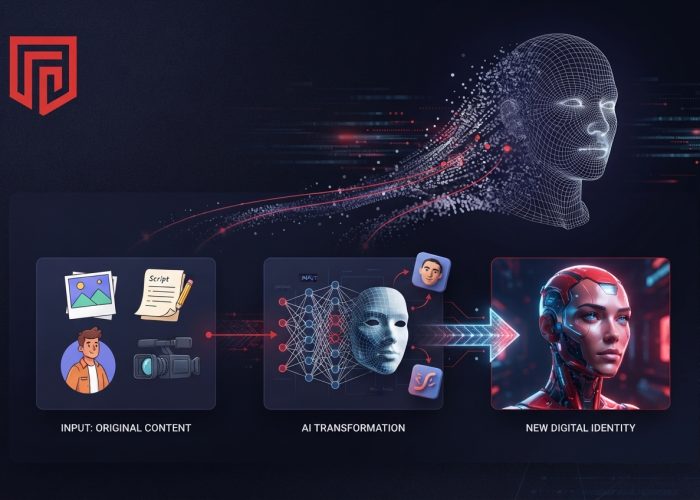
Video production has always been closely connected to people.
Actors perform in front of cameras. Designers create characters. Photographers establish visual identities. Editors bring everything together into a finished story.
Generative AI is changing that relationship.
Today, a video can begin with a photograph, a written idea, an illustrated character, or even an existing video. The person or character on screen can be transformed, repositioned, or placed into an entirely different environment without traditional filming.
This is creating a new kind of digital production where identity itself becomes a creative asset.
From Recording People to Creating Digital Identities
Traditional video production captures a person’s appearance at a particular moment.
AI-based workflows can treat that appearance as reusable visual information.
A single portrait can become the reference for multiple scenes. A fictional character can be placed into different environments. A product model can be reused across several advertising concepts.
This is one reason image-based video generation has become so interesting for creators.
Instead of starting with a blank video timeline, they can start with something that already exists.
The Image as the New Starting Point
An image contains information that would otherwise need to be recreated manually.
It establishes:
- The subject
- Composition
- Lighting
- Clothing
- Environment
- Color palette
- Facial appearance
- Visual style
An AI image to video generator can use that information as a starting point and introduce movement around it.
For example, a creator might have a finished character illustration and want to turn it into a short cinematic sequence.
The image provides the character and scene.
The AI provides the movement.
This separation between visual design and motion generation gives creators another layer of control.
Why Text Still Matters
Images aren’t the only way to begin a video.
Sometimes there is no reference image at all.
A filmmaker might have an idea for a scene but no footage, concept art, or production assets.
This is where an AI text to video generator becomes useful.
Instead of providing an existing visual, the creator describes the scene using natural language.
The system then attempts to interpret:
- Subject
- Environment
- Camera movement
- Lighting
- Action
- Style
- Atmosphere
The creator can start with nothing more than an idea and gradually turn it into a visual sequence.
Two Different Ways to Build a Scene
Image-to-video and text-to-video therefore represent two different creative starting points.
Image-to-video:
“I know what the scene should look like. Now I want to make it move.”
Text-to-video:
“I know what I want the scene to be. Now I want AI to visualize it.”
Neither workflow completely replaces the other.
In fact, creators can combine them.
A text prompt can generate an initial concept, the resulting image can become a reference, and that reference can then be transformed into video.
Face Swap Is Becoming Part of the Same Workflow
Another technology becoming increasingly connected to generative video is face swap video.
Traditional face swapping was primarily associated with entertainment and visual effects.
Generative AI is expanding the concept.
A face can potentially be integrated into a different character, scene, or video while attempting to preserve recognizable facial characteristics and expressions.
This creates new possibilities for:
- Creative storytelling
- Social content
- Advertising concepts
- Character experimentation
- Visual effects
- Personalized media
However, face-related generation also introduces an important responsibility: creators should have permission to use someone’s likeness and should avoid misleading or deceptive applications.
Why Identity Consistency Matters
One of the hardest problems in generative video is consistency.
A character may look correct in one frame and slightly different in the next.
The same problem can occur with faces.
For a short experimental clip, that may not matter much.
For a commercial campaign or narrative project, it can become a major issue.
This is why modern video workflows increasingly use reference images, character references, and identity-preservation techniques.
The goal is not simply to generate movement.
It is to maintain the visual identity of the subject while that movement occurs.
The Creator Becomes More Like a Director
Generative AI doesn’t necessarily remove the need for creative expertise.
Instead, it changes where that expertise is applied.
Traditional production requires creators to spend significant time operating cameras, arranging lighting, preparing sets, and editing footage.
AI-assisted production shifts some of that effort toward:
- Selecting references
- Writing prompts
- Designing characters
- Choosing camera movement
- Reviewing generations
- Refining outputs
- Combining different clips
The creator increasingly acts like a director of generated material.
AI produces possibilities; the human decides which possibilities belong in the final story.
One Character, Multiple Worlds
Consider a fictional character created for a digital campaign.
Instead of producing one video, the creator could potentially develop an entire visual series.
The same character could appear in:
Scene 1: A modern office
Scene 2: A futuristic city
Scene 3: A historical environment
Scene 4: A product demonstration
Scene 5: A short social-media sequence
The character becomes the constant element while the environment changes.
This kind of workflow would traditionally require multiple production setups.
Generative AI can make experimentation with these variations significantly easier.
The New Production Pipeline
A modern AI-assisted video project might look something like this:
Stage 1 — Idea
The creator develops the concept through text.
Stage 2 — Visual Development
AI generates images, characters, environments, or storyboards.
Stage 3 — Identity
Reference images establish the appearance of important characters or products.
Stage 4 — Motion
Image-to-video or text-to-video generation turns concepts into moving sequences.
Stage 5 — Transformation
Additional techniques such as face replacement, editing, or visual effects can modify individual shots where appropriate.
Stage 6 — Human Editing
The strongest generations are selected and assembled into the final narrative.
This is fundamentally different from traditional production because the boundaries between pre-production and production become much less rigid.
AI Video Is Becoming More Modular
Another interesting change is that creators don’t necessarily need one tool to perform every task.
One system may be better at generating images.
Another may provide stronger motion.
Another may be more useful for avatars.
Another may offer specialized editing.
The creator can combine these capabilities into a larger pipeline.
This is similar to how professional creative teams have always worked with specialized software—except AI makes the transitions between those stages increasingly automated.
The Importance of Human Judgment
Despite impressive advances, generated video still requires careful review.
AI systems can produce:
- Inconsistent faces
- Unnatural movement
- Incorrect object interactions
- Changing clothing
- Distorted hands
- Unexpected camera movements
The solution isn’t necessarily to avoid AI.
It is to treat generation as an iterative process.
Generate.
Review.
Modify.
Generate again.
Then edit the strongest results together.
Where the Technology Is Heading
The long-term direction appears to be moving toward increasingly connected creative workflows.
Instead of having separate categories for:
Image generation
Video generation
Face transformation
Animation
Editing
these capabilities may increasingly become parts of one larger creative system.
A creator could start with a sentence, turn it into a visual concept, establish a character, animate the scene, modify the identity, and produce multiple versions without leaving the same workflow.
The Bigger Change Isn’t Video Quality
Better resolution and more realistic motion are important, but they aren’t the only significant developments.
The more fundamental change is control.
Creators increasingly want to control:
- Who appears in a scene
- What they look like
- Where they are
- How they move
- How the camera moves
- Which elements remain consistent
- How the story develops
The more control AI systems provide, the more useful they become for real creative production rather than simple experimentation.
Final Thoughts
Generative AI is changing video production by making the relationship between identity, images, text, and motion increasingly flexible.
An AI image to video generator can transform an existing visual concept into a moving scene, while an AI text to video generator can turn an idea into a completely new visual sequence.
Meanwhile, face swap video technology demonstrates another direction: the ability to treat visual identity as something that can be modified and integrated into new creative contexts.
These technologies aren’t eliminating the role of the creator.
Instead, they are giving creators new ways to direct, experiment, and iterate.
The emerging AI video workflow may ultimately look less like traditional filming and more like directing an intelligent visual production system—one where ideas can move fluidly between text, images, characters, identities, and video.